Episode Transcript
[00:00:00] Speaker A: Foreign.
[00:00:11] Speaker B: All right, thank you everyone. Thank you for that introduction. My name is Michael Commisen with Key Code Media. Thank you to the last stop. To all of you for coming to our last stop in the post nab roadshow. We've blown it out across the country this year and we're thrilled to be here. The last leg.
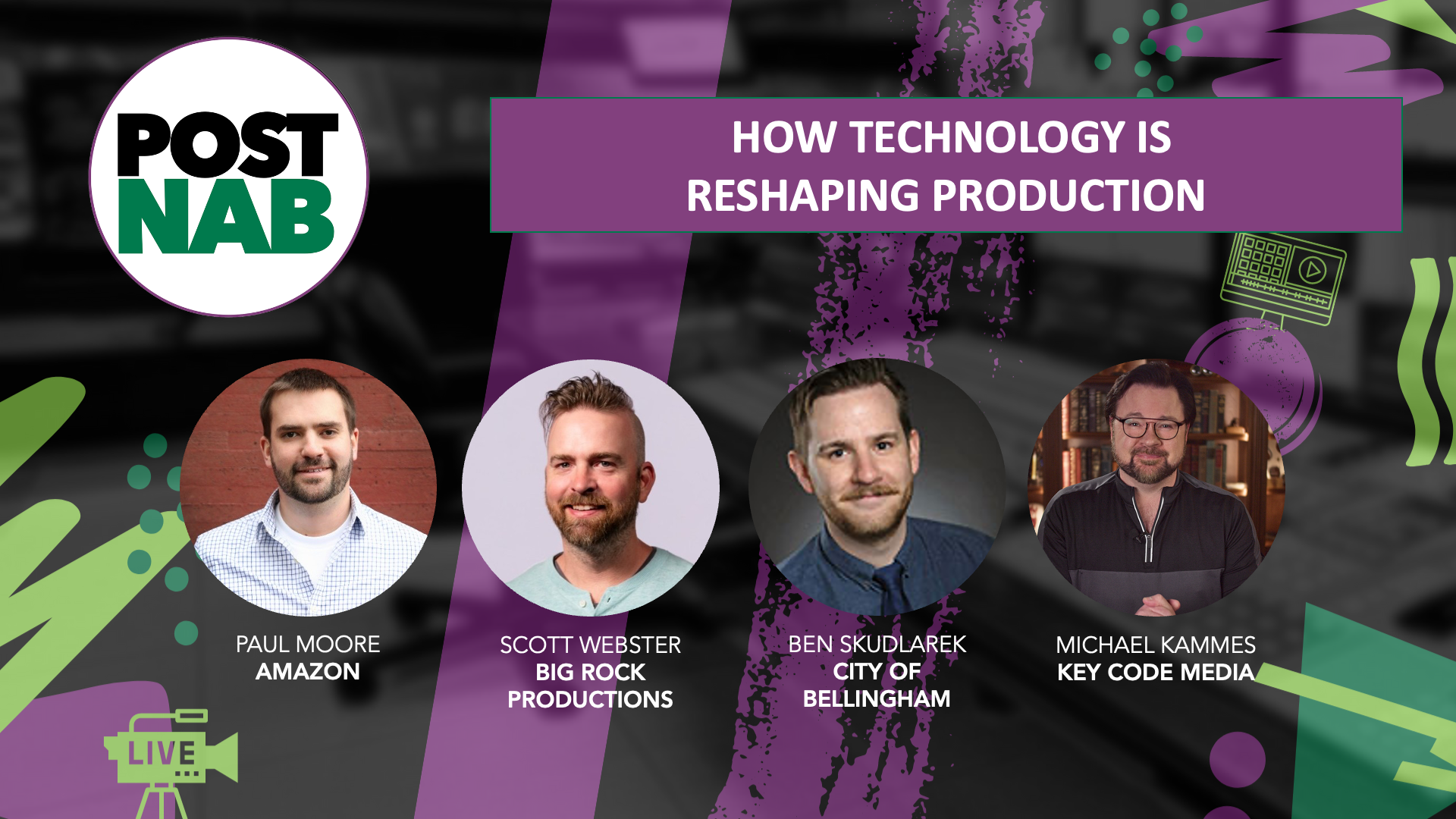
So we have a great panel for you this morning. We're talking about how technology is reshaping production and I have three esteemed guests on stage with me and rather than me try and read a LinkedIn bio, I thought instead I'd ask each person to introduce themselves so you kind of know where they're coming from when we get into the discussion. Right. So Ben, do you want to start us off?
[00:00:45] Speaker C: Sure. I am Scudlarick. I'm the television station coordinator for the city of Bellingham.
We are in charge of much of the media operations for the city.
Two person operation. So imagine the kinds of things you can accomplish as a two person operation. That does include obviously live coverage of city meetings, live events that aren't city affiliated, concerts, presentations.
We also do a lot of scripted, post or pre produced things, PSAs, things that are relevant to getting public information out there.
[00:01:24] Speaker B: Thank you, Ben and Scott.
[00:01:26] Speaker A: Yep. Scott Webster with Big Rock Productions. We're a creative and technical production agency.
We produce events, mostly corporate events locally in the Pacific Northwest and all over the country.
Sort of tip to tail from design all the way through to on site execution.
[00:01:47] Speaker B: And last but not least.
[00:01:49] Speaker D: Yep. Hello everyone. My name's Paul Moore. I work for Amazon Web Services in the training and certification org.
I'm a studio manager and operations manager.
Primarily we do training content for aws, the cloud, a mix of video on demand content, live content, Remy Production and live streaming.
Sit on a team, about nine people and we have a studio in Seattle, one in Virginia and then partnered with studios kind of globally. So.
[00:02:19] Speaker B: Yep. Thank you.
Let's start kind of high level. There's been a lot of different technology trends that are happening. Whether it's video over IP, whether it's from working remote, whether it's something that's SaaS based, whether it's AI. So I'd love to know what kind of industry trends are all of you seeing that's kind of impacting how you are handling and supporting your creative teams.
And why don't we start again with you, Paul?
[00:02:41] Speaker D: Yeah, so let's see. I joined our team about five years ago and back then we were kind of doing everything ISO recording and then putting everything in post. We Moved quickly into live to tape, getting everything together and switching everything live and moving more of our post production into the production realm and then editing after that and kind of fixing everything from there. We're kind of heavy on the live stream, heavy on the remote production. I think a big influence was Covid for remote production. How do we take, how do we make sure that people don't have to fly to our studios in Seattle when they're on the east coast or something and we can pull them in remote, still have the same quality and same kind of feel that we need for our training content while making sure that we're reducing costs and they have a good experience from a presenting side, trend wise.
Currently I'm going in through a transition of hybrid SDI and NDI workflows.
Actually this last week we redid our entire control room and server room. So I am currently in the configuration stage. So that's a fun journey.
[00:03:56] Speaker B: Right now, I guess you mentioned SDI and NDI and I'd just be. As a quick follow up, I'd be curious, what was the decision to go with NDI over other video over IP transmission methods?
[00:04:07] Speaker D: Yeah. So to be perfectly frank, Amazon is a big place and a different studio was shutting down and I got all the equipment for very low cost.
But also I think for us NDI was a little bit easier to step into than let's say SMPTE 2110 or anything like that. Just kind of our background in our team is mostly post production and producers not coming from live stream scenarios. So we're more or less like I have to kind of stair step our studio and our workflow to meet our team's needs. So.
[00:04:43] Speaker B: And Scott, I'd love to hear what technology trends in the industry are affecting you and your creative team.
[00:04:49] Speaker A: Yeah, I think it's really looking at event as a ecosystem that exists outside of just in the room. It's pre content, it's in the room content.
Content that lives on after the event is over and reaching an audience that maybe never showed up in person and maybe was never planning to show up in person. And so an event that reaches an audience beyond, you know, the four walls that the event is happening in.
[00:05:26] Speaker B: So that sounds like it's a little bit more.
Less technology based and more engagement and viewership based how you're jumping or connecting that as opposed to what technology could you throw at it?
[00:05:38] Speaker A: Yep, yeah, exactly.
[00:05:40] Speaker B: And Ben, what about you? What technologies, what newer technologies are you seeing in the industry that's affecting you and how you're Handling your creative team of one or few for sure.
[00:05:49] Speaker C: So yeah, there's, it's a, it's a two person operation at btv, but the city has doubled its communication staff in the last few years and those people have been given the purview of creating video content.
And what we are seeing now is the need for.
Well, let me take a step back because content is going like. It's not just broadcast tv, it's not linear television, it's not even linear television first. And that's been true for a long time. But the number of places that a piece of content has to go is.
I mean, you know, it used to be two places and now it's probably six or seven. And they all have their own needs. They may want to be tailored to that particular platform, but it all has to come from the same place. So the need for like robust media asset management is greater than it's ever been. We're a bit slow on the uptake there. I have a lot to learn and a lot to adapt to in that space, but the need is there.
[00:06:52] Speaker D: 2.
[00:06:53] Speaker C: The sum total of quality of life improvements that we have in any editing suite over the last five years mean that editing looks so much different than it did five years ago. When I was asked to be on this panel, I was like, nothing's different since the last time I spoke. I don't really have much to say. But when I look at what editing looked like in 2021 versus what editing looks like now, even just simple stuff, transcription based editing, which is a game changer for editing, means that editing looks completely different.
Three, and I'm almost loath to talk about this because it's, there's nothing simultaneously more interesting and less interesting than talking about AI at like a tech conference.
[00:07:41] Speaker B: Let's, let's pause for booze. Any, any villagers with pitchforks? No.
[00:07:48] Speaker C: The ability for me to create.
And when I say create, I mean Vibe code, a bespoke one shot app that does exactly the one thing I need it to do is huge.
I make one probably once a week, once every couple weeks. It does one thing and it does it well. And that's all I need it to do. And it just lives on my machine and that is, it's crazy.
[00:08:19] Speaker B: Okay, sorry, let's wait for a little bit more.
[00:08:21] Speaker D: I mean we can, we, we can,
[00:08:23] Speaker C: we can dive into it more, but it's, it's wild.
[00:08:27] Speaker B: Well, let's, let's stay on the AI tip just a little bit for the other panelists of what you can Talk about regarding AI, is it something that you've been incorporating into your workflows or something that your creative teams have been incorporating to kind of augment all, all the work that has to be done for all these different deliverables and all these different responsibilities?
[00:08:44] Speaker D: Yeah. So obviously at Amazon there is a huge AI push. I don't think anybody, if anybody hasn't noticed that Amazon's obsessed with AI.
You're missing out, I guess.
So for us specifically AI, we're being asked to look into every part of our business for AI, specifically video.
We're leaning a lot into AI avatars for training content, using software to essentially upload a script.
Out pops a rather good looking avatar and then putting that into post production and cleaning it up. What we've noticed is while it looks rather real, it looks good.
Our business leaders want time savings, but it's actually pushing our kind of production into post production.
So it's still taking the amount of time, whether it's rendering time or trying to batch process things, or you have a five minute script and it batch processes one file and then one minute in, it has a six fingered person staring at you. You have to batch process the whole thing again.
So what the, the team I'm on is looking into mainly is using AI to essentially make apps to bypass those things. So we're splitting up scripts into much smaller chunks and then using AI to kind of restitch that together, still bringing it into Premiere and editing it from there. But it allows us to fix just portions of the rendered video rather than kind of redoing everything.
Also with the AI stuff, we're doing a lot of kind of how to implement AI workflows that aren't necessarily video specific, but more workflow specific. So creating scripts with it just as simple as what I'm kind of working on right now is as I'm updating the studio and control room, all of our signal flow is changing.
We have a lot of producers that want to just walk in the studio and go, so we're creating a chatbot or a chat agent to interact with signal flow, do kind of routing automatically and then at least they have something to talk to before they come to me if I'm busy to help them troubleshoot and fix something. So we're, I look at AI as more of a workflow improvement, less as like a replacement tool for what we're doing. So.
[00:11:15] Speaker B: Scott?
[00:11:15] Speaker A: Yeah, I would, I would agree that we look at AI. I mean we're a, a team of 15 or 16 and across, you Know, multiple workflows, but, you know, looking at AI as more of a process improvement, but also, you know, having conversations around how.
How much does AI.
How. How do we incorporate it, or do we want to incorporate it? Do we.
Is. Is what we're doing executed and designed by humans? Is what we're doing designed by AI? Is there value in saying that this was designed by humans and we are executing this by humans, and we have those conversations all the time, but in the interim, it's really using it as a tool to improve a process, not necessarily in replacement of anything.
[00:12:13] Speaker B: And I think it's important to make sure we have the distinction between the generative AI and analytical AI. Right. Because analytical are the things like help to write new apps. Right. To not replace, but augment so you can push more stuff through. That avatar is a little bit more generative than analytical, but to the analytical point, that's not replacing. That's just making you more productive in the same amount of time.
[00:12:34] Speaker A: Yeah.
[00:12:36] Speaker B: So let's also talk about the role of remote teams. You mentioned the pandemic. Obviously, people were working from all corners of the earth, but in some ministries, we've actually seen a little bit return to the office. Right. So have you seen that as well? The folks you're working with now? We're now having people go back to the office, or is it. No, we've ironed out this remote workflow and we're sticking with it.
[00:12:59] Speaker D: So it's a combo for us.
I'm in the office quite a lot. My team's in the office quite a lot. We have a lot of trainers spread out around the world within Amazon. They do want you to go to the office. We do participate in the Office a lot, and since I own a specific space, obviously I need to be there quite often.
But we are balancing between the studio production and the hybrid production and the remote production.
We're always trying to make sure that our trainers at home have a good setup so they can record remotely or live stream remotely.
Kind of what we're running into more is all of the people that want to create content just.
They always are like, I have an iPhone. I can just do this. And I'm like, technically, yes, you can record a video.
But then they turn around and they're like, how do I edit it? Where do I post it? How do I make it look better? So we're pushing people to interact with our team before they start that process and give them help, suggestions, equipment, at least be present while they're recording something. So that if, if we need to fix anything, we can do it there instead of having one of our editors just like chop everything up and make it look amazing, but took two days for him to do so.
[00:14:20] Speaker B: Go ahead.
So there's also the concept when you're working in a remote methodology of synchronous and asynchronous. Right. You can have a platform in the cloud that everyone logs into and you're using virtual machines and shared storage and all that and then there's kind of a push pull right where there's a cloud repository and then everyone's downloading and working with that content. Are you finding more folks who are doing the latter where it's we're going to push everything to the cloud and then download and work with it locally or is are you seeing a more centralization to a platform, whatever it may be, and then people remoting in and using that?
[00:14:52] Speaker D: Yeah. So I would love to get it centralized cloud platform.
Due to security concerns at different applications and software, it takes a long time for us to onboard software securely and then scale it. So as we're testing those things, things that probably would work a lot better for us, we actually usually upload things to S3. They download it and edit it locally and then push it back up if it's in the traditional like shoot and edit scenario. If we're doing live content, we are using AWS media services to push content and keep it in the cloud as much as possible.
But trying to use kind of third party software is somewhat challenging just due to scaling it and going through a security process.
[00:15:40] Speaker B: And Ben, what about you and your small focus team, shall we say?
[00:15:44] Speaker C: Luckily my purview is the geographic bounds of the city of Bellingham, which means I could probably bike to a location in 15 minutes. So remote contribution is not really something we deal with too much. The combination of parsec and frame IO pretty much covers our needs in terms of cloud based. I can log into my much more powerful computer in the office or parsec and just work off the local nas, you know, using remote desktop software. It's, it's. We're not doing a ton of if any like remote contribution.
[00:16:16] Speaker B: And Scott, is anything applicable?
[00:16:18] Speaker A: Yeah, we were 100% in in the office. Plan everything in person, go to somebody's office to have a meeting, discuss it all and then go and do the execution of the event, wherever that was in the world. And, and through the pandemic that's completely turned itself around. We're almost exclusively remote planned. We don't Really, I could count on one hand the number of times I've gone into a client's office to have a planning meeting. It's all done virtually and obviously the execution is still happening in person.
But we're pretty much a primary cloud based post production workflow at this point as well.
Recording it wherever it's happening and then it's immediately posted online. All of the editing is happening collaboratively across multiple teams spread out all over the world.
And so it's, you know, it speeds up, you know, considerably, the post production workflow that way.
[00:17:20] Speaker B: Given the fact that all of you are doing things a little bit different in production and post, I'd love to hear kind of what tools you can talk about that you're using. When you don't have everyone in one centralized location. How are you monitoring things that are being shot live? Are you taking a line cut out of the switcher and that's being streamed somewhere and you have people making comments or what is kind of the workflow of the live production with remote users?
[00:17:40] Speaker D: Yeah, so our workflow for live production would be kind of a streaming it a line cut to kind of a video player that I've set up that's password protected.
We do utilize frame IO for kind of revisions after editing has been done.
We only have certain access to frame IO, so it's not kind of everything we wished it could be for our needs.
And that's not a frame IO thing. That's our problem.
And then so we're kind of working a lot into the Remy for Live, specifically Remy production workflow. So an example is a couple months ago we had a Amazon ADS event that was in Paris and then Dusseldorf and we used a live view to send back back. They used the liveview to send back four channels. We had comms to them.
We switched the entire live stream show From Seattle in 3:00am in the morning, full comms with a second of delay.
And we had our engineer on site who was kind of managing the stream and built the whole workflow.
And there was two of us back in Seattle just switching the show and that that's hopefully becoming more of the reality where we can send at least for the live stream and not the in person experience. Send one or two people, pull the feeds back and have a lot more dedicated infrastructure that we kind of control and then push to the live feed. And that allows us to in theory cut multiple shows for different platforms, use different camera angles that would not be used in person.
So yeah, I mean, I think for me the Remy workflow is Super Interesting. The LiveView workflow that we have works really well with the comms and it's saved a lot of time and a lot of money for different teams around Amazon. So we're trying to, my team's trying to scale that out past our small team. But Amazon is a bit siloed so it's kind of hard to get your team out there and then have other people want to work with you.
[00:19:50] Speaker B: And Scott.
[00:19:51] Speaker A: Yeah, we've, we do it both ways. We'll do, you know, exclusively in the room, everything hardware based, record it all in, in space, take a program, cut ISO, every camera or every source, grab all of that footage immediately. It gets posted back online into.
There should be a frame IO rep here somewhere. But frame IO for, for, you know, collaborative editing with clients. We've, we do, you know, we, we do sort of central command with remote outbound or inbound and have done that as well. But at the end of the day we're still regardless of where it's being cut or where the, the event or whatever is that the broadcast is happening from. We're, we're recording it with hardware and then it's getting, it's getting sent to some sort of cloud based frame IO for the collaborative hosting and editing for
[00:20:46] Speaker B: all the innovation that, or we could also call it iteration I guess depending on who the marketing person is.
But what problems still exist in today's production post production arena given all this innovation and iteration? What still, where is there still a gap?
[00:21:03] Speaker D: I think for, for us it's one, it's the content.
We were waiting a lot on the content and where they might post it or want to post it.
So that kind of.
We have to start once the content's either made or at least thought of.
I think the gap for us is really explaining what our team is capable of doing for non video people and the benefits to the company about what video can do for a business, especially for training.
Our training content is video but it's also texts, it's labs, it's a whole experience and a lot of people want to skip over the video because they believe it's a slower process to make and it's actually we've got it down so it's really fast for us to do so. I think the communication of what video can do for the business for us and then just kind of explain our capabilities and explain why if you involve our team we can make higher quality content faster than if they want to just go do it on their own.
[00:22:21] Speaker B: That's really interesting to hear because of the explosion of social media and you know, being a, the visual medium, being the way that information is conveyed, for folks not to see that there's value to that just intrinsically is really, really strange to hear.
[00:22:34] Speaker D: Yeah, I think it's.
I believe that like a year ago we were doing longer form content. So our course may be three hours long of videos, but they're split up into three minute, five minute sections.
And now we are moving more to what we're calling kind of micro credentialing or micro badging. So like if you want to learn about a specific service at Amazon, you can just search in our platform for just that and it will kind of show you a three minute segment rather than going through an entire course or trying to get certified in all of aws. So it's a mix. I would say it's a mix. And I think the platform that we post on is called Skill Builder and we're going through a lot of different testing of different types of video, whether it's AI generated or, or an actual trainer doing it live or anything like that. So video is definitely there. I just think it's harder for maybe a content developer to kind of understand how that video is created in their timeline that they need to get something done.
[00:23:45] Speaker B: And Ben, I'm sure you have a ton of opinions on this.
[00:23:49] Speaker C: So how many people here work for a public entity?
University, government? Okay. Oh my gosh. Like most. Half. Most.
So in 2022, the federal government told every public agency that in 2026, April 25, 2026, that 100% of our content had to have audio descriptions.
[00:24:14] Speaker B: Is everyone familiar with that?
[00:24:15] Speaker D: Depending on their size of your township.
[00:24:17] Speaker B: Okay.
[00:24:21] Speaker C: At the time most, and I think, I think this is still true today, most platforms do not support descriptive audio or secondary audio programs. And when I say everything, I mean your social media post, your Instagram posts, your Facebook posts, your YouTube. YouTube does, I think work now. But anyway, we found out one week before the deadline for 100% of our content to have audio descriptions that actually we didn't have to. They were going to postpone it for a year. And I say this because there's a huge gap in one just being able to accomplish some of the accessibility things. This isn't an argument against accessibility things. It's necessary, it's good. We want to get that information to as many people as possible.
We don't want to exclude anyone based on their ability.
That said, if the technology does not exist to do it in a reasonable way, how do we actually do it?
We talked about it for years. There was lots of, well, AI will fix it. You know, 2024, AI will fix this in a year and a half. And we were, you know, it was, we had our meeting, our board retreat, April 18, something like that. And it was like, so has AI fixed this yet? It has not so huge gap in terms of being able to provide some of the accessibility things that we're being told that we will have to do.
Other gaps
[00:25:46] Speaker B: while you're thinking of that. I don't want to plug a particular product or I'm up here, but if you haven't heard of Castus C A S T U S, they have just shipped a product that does that and it's really good. Keycode MIDI will have a video out about it really soon. Really excited to show it to you, but I'd recommend checking them out.
[00:26:05] Speaker C: No, that was great. I couldn't think of anything else. I blanked. Thank you, Scott.
[00:26:11] Speaker A: I have yet to see someone solve the Venn diagram of cheap, fast, good.
And the definition of cheap, fast and good continues to change.
What was fast five years ago?
Nine month pre production timeline, content delivered in a week or two. That's no longer fast, that's slow. Now we're doing three month pre production timelines and content needs to be delivered in 72 hours. But it still needs to be cheap or it still needs to be good. And what's the definition of good? The expectations of attendee experience is different. Good six years ago, five years ago is no longer good.
So that's my Venn diagram and I
[00:26:55] Speaker B: imagine with the expectations of fan experience, user experience for live production that's just been amped up to the point where you're now upping your game two or three times every year, but still having to meet that lower price point and time 100%.
[00:27:11] Speaker A: Yeah. The ex. The expectation of the in person audience, the expectation of we're doing, you know, that's one show is multiple content streams, multiple attendees. There's the in person, there's virtual attendees.
How long does this content live? It lives in perpetuity. Where does it go? It's got to go across multiple channels.
[00:27:32] Speaker C: So yeah, I thought of my second one. Excellent.
Because we live in the Wild west era of AI adoption and I don't know if PBS is here, but you did a wonderful, genuinely wonderful piece on how the city of Bellingham uses AI.
There's a huge gap in establishing the ethical guidelines around AI usage. The fact that I can in resolve clone somebody's voice and change what they say or change the inflection. You wouldn't blink twice if you had done it in izotope, right. If you had changed the way somebody says somebody, the way somebody says something. But if you clone their voice and then speak it the way you think it should be said, that's like a huge ethical concern, especially for a government entity. Less so for, you know, fiction content or narrative content. But we have to figure out where the boundaries lie for ethical adoption of AI use.
[00:28:31] Speaker B: I was speaking with a friend the other day and the analogy we kind of came up with is that analytical AI is great, but maybe this will. Generative AI will kind of be like Google Glass, right? Great in concept, but no one was ready for it. And remember the term glass holes, right? There was this big public perception of how bad it was. We almost got a decade moratorium until we were ready as a society to accept the fact that someone could be shooting us with their cameras on their glasses. So I know there's some folks who are just hoping, right that Genai doesn't get there. And we have a kind of 10 year moratorium.
So we're going to open this up to questions. And while you're thinking of your question, I did want to ask each of you the same question, which is if you were giving advice to someone who was getting into the M and E racket today, what advice would you give them?
[00:29:18] Speaker D: Yeah, so my advice is to well, I mean obviously get your basics as far as if you're I guess understand all under. Sorry, say yes to every opportunity when you're getting into any part of the production process and post production process.
When I started I thought I wanted to be a director, probably like everybody did. I quickly was like I do not. I really like the technical side camera operation and then leaned more into kind of technical directing.
In school you have that opportunity to kind of do everything and then right out of school just say yes to everything, no matter the, the, the payment or non payment that you would get. And then I think for me right now is like learning networking, learning how to kind of get into AI, whatever that means to you.
It's not video related but like home labbing.
Getting old an old PC and kind of spinning up your own way to learn how computers work, how networking works, how video signals go across networks or in through, around through around your networks has been huge for me.
I don't have a networking background, I don't have a developer background, but I do now run our network for our Studio, which is vpn across multiple places. And we'll just say that I kind of know what I'm doing. Dangerous enough to fix something, but also can completely destroy it in an afternoon and then rebuild it. So, yeah, I think just be open to every opportunity that comes your way and then if there's no opportunities, seek out people that are in the industry. I think most everybody loves to share their information and wants. I mean, if anything, if anybody wants to come and run cables for me, I'm going to gladly say yes. And you'll probably learn a lot from that.
All right, Scott, what would your advice be?
[00:31:32] Speaker A: Yeah, very similar.
I made a whole career out of always saying yes and kind of knowing what I was doing. Right. So I think that's great advice is, and I've given it more than once is just say yes. Don't ever say no. Try it out. You never know where you're going to end up in this business and network.
It's not what you know. A lot of the time it's who you know. It's knowing who to ask and being open to asking questions and knowing when you don't know the answer and when you should seek out that advice and whatever technical or project management or whatever it is. So yeah, say yes, Scott.
[00:32:16] Speaker B: I love that line and I followed it for years, which is wisdom isn't knowing everything, but it's knowing where to get the answer 100%. That's you're, you're dead on.
And Ben.
[00:32:25] Speaker C: Yes, exactly that.
So earlier in my career I had, I was asked to give like a three hour like production boot camp. And I spent like probably an hour of it, like teaching kids how to wrap a cable. And to this day, I regret spending so much time teaching children how, teaching like, you know, 16 year olds how to wrap cables, because it's like, this is not the important part of production. It's the important part to me.
[00:32:53] Speaker E: But.
[00:32:55] Speaker C: So any advice? This is all to say I don't have good advice to give.
[00:33:01] Speaker B: It sounds like you're recommending don't do cables.
[00:33:03] Speaker E: I don't know.
[00:33:03] Speaker A: I've watched somebody wrap a cable the wrong way and it is torture.
[00:33:06] Speaker C: So honestly, I, I, I get it. Kids, excuse me, people getting into this now are digital natives who grew up with really good cameras in their hands since they were children.
I genuinely don't know that I have advice to give aside from like, be open and communicative and know how to ask questions and some version of like, I don't know what the modern version of like learn how to Google is because.
[00:33:40] Speaker B: Learn how to what?
[00:33:41] Speaker C: I'm sorry, Learn how to Google because we, those of us that grew up in the before times and then the Internet came, we were like, oh my God, we can, we can get all of our answers solved by just searching for our answer. And yeah, maybe AI is the new version of that, but like learn how to ask a question.
Yeah. Learn how to find the information. Like be open like you said. Learn.
Recognize what you don't know and learn how to ask.
[00:34:14] Speaker B: Excellent. So now we're going to open it up to questions.
Feel free to ask anything. Our VP of marketing, Matt McLain, who's built this from nothing, will be the Mike runner
[00:34:28] Speaker F: with the Sorry Mark with
[00:34:30] Speaker D: the city of Richland.
[00:34:31] Speaker F: We just had a consultant come in and he wrote a book as the the Playbook for Local Governments and How to Navigate Social Media.
So I'm wondering how you're, you know, you talk about the traditional broadcast platform and now you've got, you know, so many platforms and they all want something a little different.
I feel like a lot of it though is chasing clicks and it's almost like a race to the bottom. They talk about, you know, be authentic. They don't want it over produced. So I feel like we have to dumb it down to reach people and just what your thoughts of that is it.
It's kind of a struggle for me. It's like, is it worth it?
[00:35:20] Speaker C: The desire to like feed the beast of social media? Like it.
I can see myself in the program in the truck and it's for someone with terrible stage fright, it is quite a sensation.
Yeah. The desire to feed the beast of social media is there.
We've been given that, or rather the communication staff at the city have been given that directive.
I don't, I don't have an answer.
My desire when I first started in 2019 was like, we're gonna be the best. We're gonna make the best city content you've ever seen. It's not gonna be like cute or funny unless the actual topic is cute or funny. Right. We're not gonna like make things unnecessarily light or cheesy because we're, we're a city government and that's sort of the content you see a lot of from cities. It's like, well, we're putting in a new stop sign.
I don't have any. Like, I totally understand what you are saying and I don't know what the answer is other than I will try to continue to make the best Content I can, that I feel like is good for the platform.
Chasing clicks.
I think you have to think about it not as chasing clicks, but like, how do I get out a piece of crucial information in a way that will get people to see it on whatever platform?
The unfortunate part of social media is that literally anybody can follow you from any geographic location. So you deal with a lot of people who are like Bellingham doing screwing up again. And it's like, you live in Abilene, Texas.
What do you care?
So I just, you know, there's. I don't have a better answer than like, make the best content you can. Like, make the best content you think you can make for the platform.
[00:37:22] Speaker D: Okay, from, from our perspective or from my perspective right now, we're going through a lot of like, what is the return on investment for social media? What I mainly, what are the, what are the metrics that we need to report on for our business leaders to think it's worth it?
I also don't have a good answer because each platform does clicks in a different way or average viewership or concurrent viewership. They're all different and they're all, they're all made for social media content creators, not businesses, not cities.
We do a lot of mix of, at least for our training and certification kind of. It's a lot of mix of what the presenter kind of wants to do. So we have some presenters, some trainers that are pretty hilarious and they want to lean into the whole dress up in a costume and like teach you something for 30 seconds. And then we have somebody that just wants to get you the information as quick as possible.
Unfortunately, I don't have the insight or the access to see what the viewership is or the metrics or what performed better.
But what I like to use or what we're trying to use social media for, at least for our team, is to kind of push people to the Skill Builder platform or push people to more content where we have more metrics or more ways to look at who. Who's potentially like top of funnel going from Facebook into Skill Builder and then what are they watching from a certification perspective, obviously different than city content. But I think social media is the hardest part for us is deciding and sticking to what those metrics are and what the benefit are. I think with.
With live streaming in general, people are. They think they're going to get thousands and thousands of people watching on Twitch or something, when in reality you're a corporate Twitch channel and you're getting 70 viewers, but that 70 is staying for an entire hour. I try to frame it in a sense of if you rented a venue or an event space and had 70 seats, it's going to cost 10 times more than having one person at home livestream for an hour with 70 people watching. Obviously a little different interaction, different ROI, but it's, it's hard to kind of explain what, what people are looking for when it is social media content, at least for me, it's hard to tell what the business justification is for our leadership. So it's a hard one, not gonna lie.
[00:40:07] Speaker A: Yeah, I, I don't know how relevant my answer or helpful it will be.
This sort of a two part answer. One is a lot of the content that we're building is, is not, it's not our, we're not, we're not building a narrative. We're somebody else's narrative and we're executing or building that content on behalf of whatever that narrative is. And we're not determining what channel it's going to go to that is being taken care of by our clients and we're supporting them in that effort. What I can tell you is for our own sort of narrative social media postings is what we've decided over the years is to narrow our focus and just be as, speak with the, with the most, what's the word? I'm looking for our, our most genuine voice and to just be as, as, as genuine in what we're saying and how we're saying it on a much more narrowly focused stream or content push than just sort of scattershot. We're going to push stuff to everywhere and try and be everything for everyone. So like I said, I don't know how helpful that is to you, but that's how we've managed it.
[00:41:31] Speaker B: Thank you. Another question in the back there.
[00:41:33] Speaker E: Yeah. I'm Josh Ham with the Bates Technical College. I'm a brand new faculty and one of the things I've been thinking about as we're shaping our program at Bates is, would love to hear what does it look like when it comes to when you find a student from a maybe four year college or a technical college, what do you feel like you wish they had when it came to abilities or when it came to skills that they don't have that you wish they would when it comes to maybe an internship or a job placement with where you guys are working right now?
And secondly, secondly, what would you encourage somebody like myself as we're molding the program?
Because we have two tracks, we have the engineering track and then we have the broadcast production track. What would you encourage somebody like myself and Ace, who oversees the engineering aspect of it to implement so that these students are ready coming out with that two year degree, that certificate, to get to work?
[00:42:37] Speaker A: I'm going to come find you after this because we're going to have a longer conversation.
But to answer your first question in order, what I wish they would have coming out is just a.
I think, and I felt like this my entire career is you can teach anybody how to wrap a cable. You can teach anybody.
You can teach most anybody how to wrap a cable.
You can pretty easily identify a BNC versus an xlr.
But what's harder is showing up on time, work ethic, being an adult, knowing how to work in a team, knowing how to communicate, knowing how to ask a question with your mouth and not with your phone. Those are the things that I think are the most important. And then everything else will work itself out. Saying yes to all of the opportunities, showing up, being ready to go and, and being positive and being ready to be a positive contributor to a team. Those are the things that are much harder to.
Well, that we just, we don't have time to teach that. Right. I can, we can figure out a way to teach you where the XLR goes. That's. Or how to wrap a cable.
And then the second. Sorry, what was the. Can you grab. What was the second part of that question?
Second question.
[00:44:12] Speaker B: What would you encourage, what would you
[00:44:16] Speaker E: encourage when it comes to a program like ours to implement as we continue to mold and shape it?
[00:44:23] Speaker A: That's the part we'll talk about later.
[00:44:26] Speaker D: Yeah, I would say for the first one.
When I was first starting out, I worked with somebody and he told me that anticipating some. If you're the first new, new person on the crew, anticipate what they are going to ask you.
I just, for some reason I was working on a commercial a long time ago or a music video. I don't even know what it was, but I was just, I was ready to. It was right when SLRs were coming out with the 5D Mark II or whatever.
And he would be shooting something and I'd be ready, anticipating that he needed a lens change immediately.
And he would just kind of look and I'd have it ready. And I think like anticipating what people on the crew may or may not want. And that also means anticipate if they don't need something right now or if it's not the right time to teach or ask a question or try to get a response.
It's that and it's saying yes to being open, to trying everything new and also making sure that people know that you don't. It's okay to not have the answer or know the answer. I, I still get.
If I don't know an answer, I'll try to say I don't know the answer. Let's figure it out. But if somebody doesn't say that and they just, I assume they know the answer and then 15 minutes go by and like the cables wrapped the wrong way.
You could have just asked or we could have walked through it. We could have stopped then and figured it out.
Being comfortable saying I don't know is a huge, huge thing.
From a technical perspective, what kind of engineering track is it? I guess is it's video engineering versus just broadcast like operations or.
Sorry, just making Matt get his exercise here with the M.
[00:46:25] Speaker A: So he's engineering tram.
[00:46:29] Speaker C: Hi, I'm Ace Wheeler. So the engineering track, it goes from like video engineering, audio engineering, touch on a little bit network and content delivery and operations of a little bit of everything. What you guys all do. Okay, so trying to implement that so students are ready for.
[00:46:47] Speaker D: Yeah, thank you, that helps. So I would say if you can implement anything cloud related, how to transport streams across any cloud, doesn't have to be Amazon, it's just any cloud kind of streaming protocols.
I would say that somebody that's learning post production needs to learn all, all types of production. And I think anybody that's more in the live production needs to learn post production.
Whether you live in that realm.
There's a million times that I can count where if I'm doing a live production, I'm thinking like an editor so that my editor doesn't yell at me later because I didn't get something for them.
So just making sure that every part of the production process is understood, whether you know it fully or at least you can talk about it or have a conversation with somebody in a post house or whatever is huge.
Video over IP for engineering is just the newest thing. Obviously networking is. I said that earlier but networking for sure.
And then communicating with people, talking to them, asking questions.
I would also say that learning how to use AI at some scale is going to be a big. I do believe that each one of our businesses is very different and even if you came to my team at Amazon, our workflow is going to be very different to a different team at Amazon. So whatever you think you know, you probably leave it at the door when you join a team. And you're going to have to learn a Whole new workflow every time you go to a different company or every time you go to a different team. So being open and always wanting to learn stuff, I guess.
[00:48:41] Speaker B: Do you want to add anything, Ben,
[00:48:43] Speaker C: just to echo what you've both already said, if can you teach a person Curiosity?
Yeah, exactly. I'm not sure that you can, but in some way you have to instill that curiosity. I think if you're going into like a broadcast engineering, video engineering, media engineering program, you probably have a base level curiosity about like how things work on the back end.
But like, for instance, in our studio, so many things are automated at this point. Like, our show is pretty much the same twice a week.
So I've got a touch panel with, you know, 85 macros on it and it can run the whole show.
I don't have to know how a 4 Emmy switching board works, but if something goes wrong, I sure do. And then I have to remember how a 4me switcher works.
So I think.
I'm sure this probably happens in the program. But if you can break things and then teach them how to fix things in an emergency, that would be the greatest skill ever.
Like, hey, figure out how to troubleshoot, figure out where in the signal chain this is likely going wrong.
Being able to pinpoint the most likely answer to a emergent problem is something that I don't know if you can teach people, but that would be amazing.
[00:50:08] Speaker B: I think to piggyback on that is that studies have shown that critical thinking amongst, shall we say, younger Americans has decreased over the last several years. And that plays right into what you're talking about, which is there's not a desire or a push to say, I need to try and think through this. And I think that's a gap. Students need to be taught critical thinking. But I think there's also the concept of, as you mentioned, don't be hyper focused, be a generalist. Right? Because if you understand what someone's doing before you and what's doing after you, you're much more valuable to the team. And I guess lastly is the be curious.
And that's one of the things that one of the reasons why we have this is so we have vendors out there that have technology that you haven't seen before, workflows and plugs in and goes ins. Goes out, as we call it, that maybe you haven't thought of before.
So being able to come here, meet these vendors, get inspired as to the technology they have and how that can apply to you is something that you should talk to your students about maybe coming to this next year. We can give them private booth tours. So thank you everyone for being up here today and thank you everyone for coming. And the show floor is now open. Thanks for watching. Broadcast to post. Don't forget to follow key code media on social media and contact us about your projects at keycodemedia.
[00:51:27] Speaker D: Com.