[00:00:05] Speaker A: Three, two, red one.
[00:00:11] Speaker B: Let's get back to a nice backdrop here.
There we go. So let's start out with who you are and what the hell you do. I could read a LinkedIn bio. I can do that. But I'd much rather have each of you come kind of tell me about yourselves and what you do in this space.
[00:00:33] Speaker C: Would you like to go first?
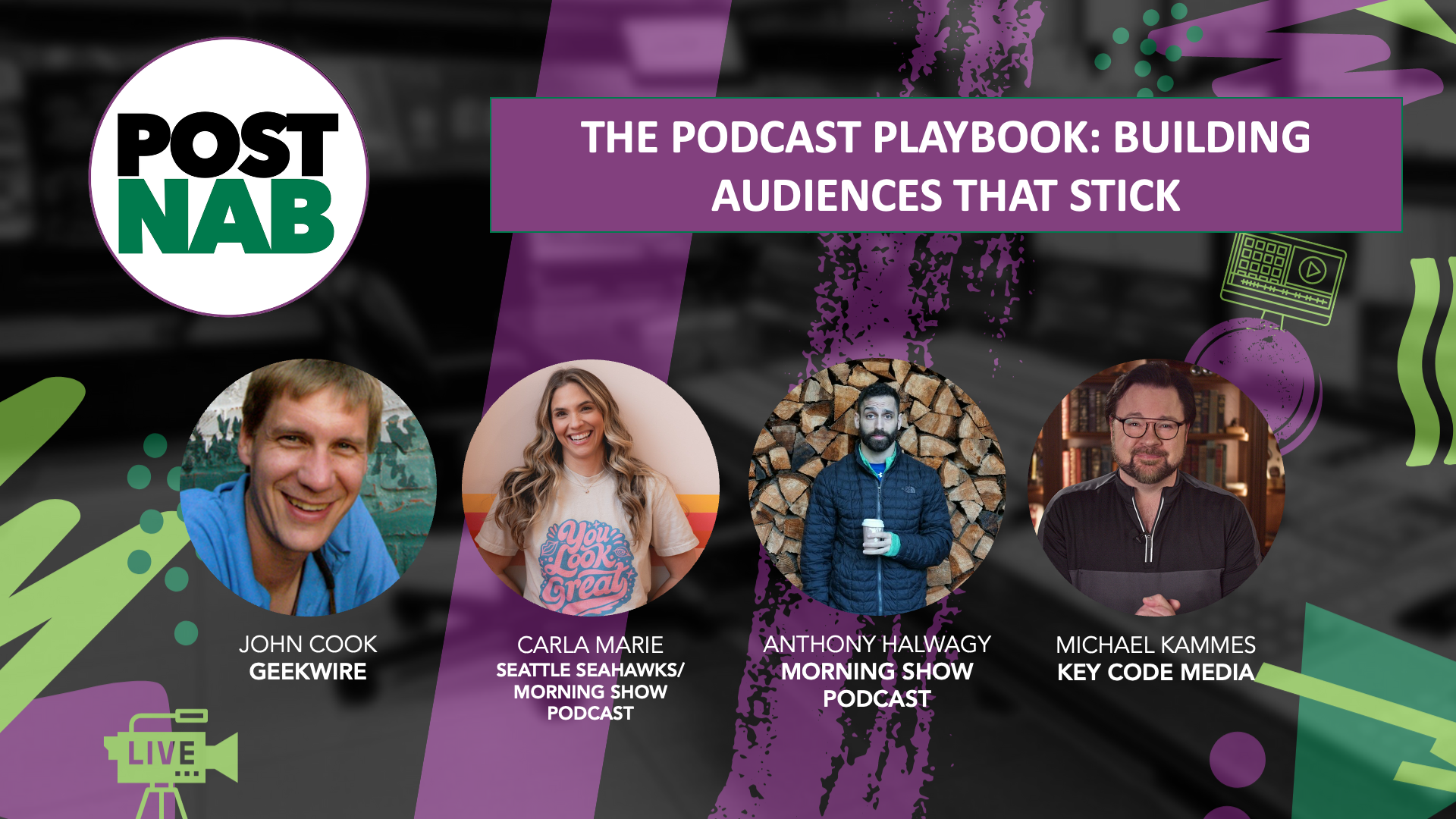
[00:00:34] Speaker A: Okay, I'll start. I'm John Cook. I'm the co founder and publisher of GeekWire. We're a technology news site based right here in Seattle. In fact, about 100 yards west of here along the Lake Washington ship canal. So when you exit today, you might see our GeekWire flag flying there on our converted coffee shop that's now our office, 15 years old. We started as traditional newspaper reporters, bloggers covering the technology ecosystem in the Pacific Northwest and beyond.
The podcast actually originated even prior to GeekWire. So we've been doing our GeekWire podcast for essentially, gosh, coming up on 17, 18 years now.
And we use that as a way to connect with our community in new and creative ways.
[00:01:21] Speaker D: Got us beat on the podcasting. I promise I wear other shirts than our own merch. I'm wearing. You look great here and there. And I was like, oh, this is so embarrassing. But hi, I'm Carla Marie. I am the in game host for the Seattle Seahawks. I also own my own media company with Anthony EMH Media. We started in radio 17 to 19 years ago. We were behind the scenes producers, then got on air, then got our own morning show and we moved out here from New York to Seattle to launch that morning show.
But the way we got the morning show was by podcasting. So we started in 2014.
We got made fun of by everyone we worked with for doing our stupid little podcast because everyone else had a radio show around us and that stupid little podcast got us our own morning show in market number 12. So everyone started a podcast when we left. I'm not even kidding. But we transitioned from traditional radio in 2020 to going independent. So we do a live stream, a daily morning show podcast. You can elaborate more. I don't want to take everything.
[00:02:22] Speaker C: Well, I was hoping you were gonna do all of it. Honestly, less work for me. So we do a daily live daily podcast. Like Carla Marie said, the morning show podcast that goes live Monday through Friday. And then we have a bi week, the twice weekly live stream, that's the Carlin Marie and Anthony show. And those are two very different products. And touching on what you were talking about earlier, Michael, we decided with the morning show podcast to go audio only first. And we did that because we knew we could do it, and we knew that we could grow after that, which is. I think one of the things that we've learned a lot is start with what you can do and then grow into what you want to do.
[00:03:02] Speaker B: That's fantastic. What kind of outlets are each of you using to syndicate the podcast to get it out there? What platforms have. Because one of the questions we had earlier today was social media, and how are you getting all of these clips out? And how are you answering the audience that each kind of market provides or each platform provides?
[00:03:21] Speaker C: Our answer is super simple. So I'll go first. We post through Megaphone, which is owned by Spotify, and setting it up takes a couple steps. But after that, it gets to almost every single podcast platform through Megaphone, and
[00:03:35] Speaker D: we respond to people. Sorry. Through the Megaphone app. Cause you can comment on Spotify, which is. I feel like not enough podcasters are using that feature that people can comment on individual episodes where Apple just lets you rate and review a podcast. Spotify now lets you comment on that episode. You can even post a poll for the episode. And it's a great way to engage your audience. Sorry.
[00:03:57] Speaker A: Yeah. And similarly, we're. We're posting to all the major podcast platforms and obviously using GeekWire as our main channel to promote the podcast.
[00:04:05] Speaker B: I'm. I'm curious, because you're using a centralized platform to kind of distribute out to other platforms, how are you measuring who your audience is, the demographics? Because obviously, if you're trying to grow your brand and there's a certain demographic that you're resonating with, how are you finding out who that is?
[00:04:21] Speaker C: For us, we actually still lean on our social media metrics to really hone in on demographics.
It gives us a better readout of where people are, age, gender, all of that stuff. So we kind of balance both of those together.
[00:04:38] Speaker A: Yeah, I would say we're just measuring through traditional means, as you are on
[00:04:43] Speaker B: that front, because we have a lot of folks here who are into, as I mentioned, zeros and ones. Goes ins, goes outs. Can you briefly talk about kind of the technology stack that you're using now? Don't have to get super granular, but just so we have a semblance of
[00:04:57] Speaker C: what kind of tech you're using, ours is pretty simple. At the moment, we have shure microphones that go into a rodecaster that feed into audition for the podcast. We use that same chain for obs for our livestream. I'm just Adding a Sony camera.
[00:05:15] Speaker A: Yeah, and I'm going to defer on that question because I'm not the technical guy on the podcast. My co founder, Todd Bishop, runs the show, so I don't even know you're
[00:05:24] Speaker D: the me of this.
[00:05:25] Speaker A: I'm just the co host.
[00:05:28] Speaker B: Front end and back end, I think, is a good way of phrasing it.
We were talking a little bit earlier about the podcast studio you put together, the visual one, and I think a lot of folks kind of get wrapped around the axle of we have to spend a ton of money to make this look good. And you talked about some strategies you had to kind of build something that was topical and comfortable but still worked, and it wasn't terribly expensive. Can you kind of elaborate on that a little bit?
[00:05:50] Speaker C: Yeah, I think first it starts with. Start with what you have and then grow to what you want. We started after we left radio in a spare bedroom, and we made that work. And then we found a space that we rent out in a friend's office building. And then in terms of designing what we did, my stupid boy brain did not know how to design anything. So that's where Carlin Marie came in and said, I'm not gonna let you deal with anything. It's just gonna look terrible.
[00:06:16] Speaker D: Well, we actually have changed it a lot. I mean, we originally had white walls behind us and lighting, LED lighting in that wall, which when you go on camera, that was terrible to try to light. So we eventually took down all of those panels kind of recently and went with a darker wall behind us, like those wood panels, and we went with pink couches because, like Anthony said, I got to decide this, and it looks great against the dark wall. But truly, like, you can. You could get that on offer up, honestly, like, you can go somewhere if you're really trying to build this as scrappy as possible. Just to start, no one needs to know where your furniture is from or how you got the stuff that you're hanging on your wall. I'm sure you have a. A closet of things that you can use as trinkets to just decorate your studio a bit. And as long as it looks fun on camera and you enjoy it, that's all that really matters.
[00:07:06] Speaker C: And I do have to add, our space currently is just for our products, so we were able to do kind of a custom space where we don't need to worry about whether or not another brand is coming in, but we also can use that because if we have brand partnerships, there is product placement that we can then do.
[00:07:22] Speaker B: So that's a. That's a fantastic part to bring up because what we've been seeing from a key code side is folks saying, well, post work's a little bit down, but we have the space. What if we convert some of our area into being a rentable podcast studio? And it's a great idea, but it does say, well, we have to make things rent, rent ready. Which means we may not have a cinema photographers coming in, we may not have a TD that comes in. So we have to automate it. So it's not dummy. So I want to say dummy proof, but that is simple enough to operate and no one's going to get hurt.
[00:07:52] Speaker A: Yeah, our space is kind of a blank slate. Much like that as well. How many people here live in Seattle and are in the Seattle area?
Okay, maybe two thirds. So you probably know the Lake Washington Ship Canal, Lake Union, the float planes that take off out of South Lake Union and head up to Whidbey island on Thursday and Fridays, when we're usually recording our weekly podcast. Well, they fly right up the Ship Canal. So our biggest hurdle is the noise issue that you pointed out, too, because those float planes are pretty loud and those engines roar on a Thursday or Friday, especially on a nice sunny weekend like we're going to have this weekend in Seattle.
So our podcast room is. Is set up very much as a studio. Very light decorations, pretty. Pretty. We don't really think too much about the aesthetics of it, but we've been in all sorts of environments. We don't really care that much. We started in a basement. We moved to a real dedicated podcast studio, which we built, built out full.
Now we're in kind of our front office conference room that doubles as a studio that has the float planes flying over us. And what we do a lot of is we like to take our podcasts on the road, actually, and do things live. We just did a podcast where we recorded on the new light rail system in Seattle on the route from Seattle out to Redmond. Of course, that's of interest to our audience. We're a lot of business and technology professionals. They're interested. They're taking that route. It's a big transportation corridor. And that was really fun, getting to take the podcast on the road. And we do a number of those types of activations as well. So really, for us, it's about just getting the show done and putting the content out there more, less so on the technical aspects and the aesthetics.
[00:09:34] Speaker B: John, to get down to kind of the basics, why.
Why did you start a podcast so Many years ago. And what, was it all altruistic or was there like I need to pay mortgage? And I think this is a way that I could do that.
[00:09:49] Speaker A: That's what I did.
[00:09:49] Speaker C: Yeah.
[00:09:50] Speaker A: It wasn't started with a, with a strict business model in mind. As I said, we were already building GeekWire. We came from more of a print print background, but it was a way for my co founder and myself to talk about the week's news and just get caught up because there's so much going on in the tech and business community that we just wanted to share what we're learning. And, and over time, the show has, has evolved and we have, we do monetize it, we have podcast advertising, we do the live shows, we do VIP events where we'll, we'll host the podcast live for a VIP dinner or something along those lines. So now we're monetizing it. But when we started, it was really a way for us to connect, share insights. And, and to this day, it's really fun when Todd and I get to sit down together and just catch up with one another. I mean, it was really. And we were starting a business together as well, so it was like we didn't. We don't have a ton of time to catch up. So it was a great opportunity for us to catch up on the week's news, share insights. And we've both been doing this for, for multiple decades in, in the community here. And what we found is we have so much information just kind of stuck in our brains that we don't really think about that. When you get us rolling on a topic, we can get going and we can share that with the larger community. And feedback is. Well, not everybody likes it, but some people, we have those dedicated listeners who really enjoy hearing our perspectives and kind of the story behind the news, which is often how we approach things these days.
[00:11:17] Speaker B: Just a follow up on that is we've seen over the past 20 plus years since the Internet's gotten huge, is that there no longer needs to be a grassroots movement to teach or learn technology.
There used to be the. Well, we all have to get together because we're all in this together and there's not enough information out there so you could be that one source. Now that we moved to a place where just about anything we want to know is already out there. How have you been able to try to keep surviving in an area in a time when the information you're dispensing, there's going to be a hundred other people, maybe not doing it as well, but there's going to be a hundred people or more doing something similar.
[00:11:54] Speaker A: And I assume that was directed at me because there's so much information overload in the technology and business space.
[00:12:00] Speaker C: Definitely not us.
[00:12:01] Speaker A: Yeah. And you guys are doing an interesting thing with the morning show because you're, you're almost an aggregator. It's like a catch up on everything going on. So your, your universe of, of what you're covering is everything. And many ways, ours is much more of a niche audience. And because we're in a niche and because we have subject matter expertise and because of where we're located and the perspective we have, we have a bit of a different take and angle than our competitors in New York or Silicon Valley or Boston or Austin, you know, the major tech hubs where we have other media competitors. And so I think that perspective resonates with our audience.
[00:12:37] Speaker B: And Carla Bareeb, back to kind of the original point is why, why the podcast?
[00:12:43] Speaker D: I could give you a why for every one of the podcasts that we have launched. And I think the easy answer is through the different parts of our lives, there was a different reason for every podcast that we did. So that first one was my day Friday. It was to practice doing a show together because one day maybe we'll have a radio show. And we did. Then I worked on one called side Hustlers, where I got to talk to small business owners who had a day job, but then they were doing something that they loved, and that was just a passion project for me. I genuinely loved hearing their stories and giving them a platform. And we've done several of their podcasts since then. But the morning show podcast for us was who wants to listen to nine plus minutes of ads when you're driving and listening to the radio? Which is where we came from, which
[00:13:30] Speaker C: we were guilty of being a radio show.
[00:13:32] Speaker D: We had no other choice. We're like, who wants to hear this? No one. So we took everything we knew from radio and like, what if we can give them a morning show for their commute that's 25 minutes or less, what would be in it? And that is how we built the morning show podcast. Because most commutes, depending where you're commuting from. Don't kill me. Are not three hours long or not two hours long. They should be 25 minutes or less.
Sometimes you might be able to catch two of our shows on your current commute in Seattle right now, but that was why it was everything we learned from radio. Put it in a podcast and make it digestible and not miserable.
[00:14:07] Speaker B: I think the common thread it sounds like is that it wasn't just a business venture. It was deep down, it was something that you felt a personal connection to. And I think there can be some disconnect there because there are people that may try and start doing it because of the money, but their heart isn't in it. And you can kind of tell with the product.
[00:14:23] Speaker D: I mean, you see a lot of time, I mean, was it smartless? I love them, but they got, it was like, oh, come over to Sirius for $100 million. I'm like, people see that and think that could be me. I mean, I hope one day Sirius wants to do that with us.
[00:14:37] Speaker C: We are for sale.
[00:14:37] Speaker D: Yeah, we can be bought. But you see that and you don't realize, like most of us are people that are just scrappy putting this together because we love it. We want to catch up with our co founder, whatever, in that aspect. It's not, oh, I'm going to be rich off of this podcast.
[00:14:53] Speaker A: Yeah, that resonated with me because the format really matters, I think, and the style and approach that you take. Because when we started the GeekWire podcast, we actually, very shortly thereafter we got recruited by Cairo Radio here in Seattle to start doing the podcasts on radio, which set up those time breaks. And it just, to me, it really disrupted the flow and the style.
It's a different animal when you have those commercial breaks. So that's one thing I appreciate about what you guys are doing and just being able to have that free flowing conversation. I think that allows you to connect with your community in a much deeper and richer way.
[00:15:31] Speaker B: On the business side, how are you measuring success? I mean, if we could take the corporate America look and say, what are the KPIs you're hitting? But we could also look at some of the organic reasons, the organic results, meaning not more viewer or not more viewers or listeners, but quality viewers or listeners. So I'm really curious to hear how you're measuring success.
[00:15:51] Speaker C: I'll go first, I guess I think one of our biggest things, there's two actually. The first is how many, because we're a daily podcast, how many people are actually coming back Monday through Friday. And the thing that we are most proud of is almost every single day our listenership is exactly the same. So we have done a good job of honing in on the audience that loves this product and making sure it is there for them every day. It gives them something different every day and they are coming back. So Those return listeners are great for us because anyone can have one podcast episode that pops off. Maybe you've got a great guest or you, you hit something that everyone is talking about. But how many of those people came back and then came back again and now have come back for four years straight? So that's one that we're really proud of. And then after that, it's how are our partners doing? How have we done in helping them build their business? Are we sending enough referrals for the links that we're posting and things like that? Because obviously, yeah, like you said, everyone can look at total audience and everyone's always going to try to get that number up. But there are so many metrics that you can hone in on that. I think it's kind of a great space for that these days.
[00:17:01] Speaker B: How was the refinement process? Because you have a core audience that's coming back watching it day after day, but it's prerecorded.
[00:17:08] Speaker C: Right.
[00:17:09] Speaker B: So how are you getting that feedback? Are you actually getting folks who were saying on social media, I didn't like when you did this or this was really good, but how do you refer to refine the show to get it to the point where it is today? And not that it's stagnant by any stretch, but how are you incrementally refining things?
[00:17:22] Speaker C: So the first thing we did was we did kind of the same show every day just so we can get our schedule in and let people know. And then we started tweaking. You know, this thing sounds a little bit redundant. We have a group of listeners that have been around through all of our different projects that we will ask questions to, we'll do research.
[00:17:40] Speaker D: We've done a full blown focus group. Like, hey guys, let's all get on a zoom together. We had 30 people and we asked them everything from the podcast to what merch do you want us, what types of style? I mean like everything. And then they're also invested because they just gave you an idea that you're then using. So and going back to quality of you had mentioned quote, like, that's a lot of it for us is the interaction. Like we thrive off of interaction. Coming from the world of radio where you would get a caller or 100 callers on a topic. For us, it's like, hey, what would you do in this situation? Even if it's like a headline, like a news story that it was Logan Airport now is letting you go to an off site TSA and then get bus to the airport, that was in today's podcast. And I was like, would you do this at your. If this came to your airport, would you do it? Comment below and let us know then. They're engaging. Then we can read out their comment today. Oh, my God. Their comment got read out on a podcast. And for us, it's just, it's more content and it's building a community.
[00:18:37] Speaker C: I do have bad news for you about the Logan Airport thing. Everyone that responded this morning was responding about whether or not their cats follow them to the bathroom, which is something you talk.
[00:18:44] Speaker D: I did also ask that do your cat.
[00:18:46] Speaker C: That's what everyone was commenting on.
[00:18:47] Speaker D: We are all the things. But that's insane.
[00:18:52] Speaker B: John, how are you measuring success?
[00:18:55] Speaker A: Yeah.
[00:18:55] Speaker C: Your cat follow you to the bathroom?
[00:18:56] Speaker A: No, it doesn't. But I did appreciate the Logan Airport story. That was excellent. And I thought that was a fantastic idea. I would also give that a try. So that was, that was wonderful.
I mean, traditional business metrics, I mean, we do look at the revenue that the podcast drives as it relates to other products and offerings that we have at GeekWire. And I mean, it's a small portion of what we do, frankly, at the end of the day, but it does have that incremental value of there are certain people that just connect with us and our brand through the podcast and that's how they know us, that's how they get to reach us as personalities, which I'm sure is very, very important for you all as well.
And that matters, that community connection to them.
And we have been able to parlay the podcast and the GeekWire brand into other ventures that have become very successful for us, including a business unit that we call GeekWire Studios, where we actually create content on behalf of other brands. So Amazon Web Services, UiPath, Remitly, some of these larger technology brands come to us because they believe and we think we do a decent job on storytelling and creating content. And so now those brands are coming to us through our GeekWire Studios unit for help in either doing podcasts, video based podcasts, a lot of video based storytelling tied into events. So it's had this ancillary benefit to another part of our business that makes us want to continue doing the podcast, even though if you look at the revenue line Item on the GeekWire financials, it's not that huge.
[00:20:35] Speaker B: So because you've all been doing this for quite a number of years, obviously the social climate has changed. I'm sure that to some extent, case studies or not case studies, focus groups aside, there's been a we need to change to speak to today's modern audience. So how would you say your content's evolved in that vein as opposed to just downwind of a focus group?
[00:20:57] Speaker C: I think. Oh, go for it.
[00:20:58] Speaker A: No, go ahead.
[00:20:59] Speaker C: When we edit, one of the things we'll do now is it's, it's tough when you're doing a podcast and it's your voice and it's your face or whatever, or your, your co host or whatever. But you have to remove your ego, especially in today's media climate and say, do I really need to say all of this? Like we go through and I'll, after I do an update on a story, I'll listen back to it and go, you know What? There was 30 seconds, there's that I was kind of redundant and I'm going to take that out because I know we are fighting for time.
So we in the morning show podcast, the way it's structured, we try to make sure that all of that time is spent wisely and we are conscious of our listeners time. So we, we do cut things out, we trim things, we re record them to make sure they are as succinct as possible for the most part.
[00:21:51] Speaker A: Yeah, that's really interesting because one of the podcasts I listen to is the acquired podcast, which runs four hours. I'm not sure if you're familiar.
And so this idea of time is interesting because I do believe that is super important. So there's a huge just variance on that, I would say in terms of who your audience is and what you have. And I think you need to know who you're speaking to and what they want. In the case of acquired, they want really deep, intensive business case studies, histories almost that span four or five hours.
In your case, it's a very quick punchy, get me caught up, have some fun in the morning and be off to the races. In our case, it's probably in between those two with a little bit of commentary and perspective on the news that we're sharing. So I think it's a matter of just kind of knowing which lane you're in and staying true to that.
But I think all of those can work.
[00:22:52] Speaker C: Yeah. And I think to just follow up with what John said, knowing your audience is the key and knowing your frequency. We have a morning show podcast, right. It's five days a week that we're asking our audience to come to. Whereas one of the long form podcasts I listen to is hardcore history every now and then that's like three months between episodes. But there's probably 16 hours of content that's going into that. So it really depends on, like you said, who your audience is and what your goals are.
[00:23:20] Speaker B: One of the things that you've all mentioned is diversification, right? It's not just one podcast. And that's what we're hanging our hat on, that you're doing multiple projects. I'm curious as to what the planning process out time is. Are you already have the next months. I mean, obviously if you're doing something in the morning, there's a little bit of rinse, repeat, at least in what the content's going to be. But how far out are you planned?
[00:23:43] Speaker D: I would say in every podcast we have done, and I mean, I'm talking about like we've done eight, I think it is total podcasts over time. We have never planned out more than a week. If, if, if that obviously the morning show podcast, I mean, we have a crazy spreadsheet.
Anthony's brain did this. It's absolutely insane when you look at it. But we can each pop in there for what our scheduled story is for the next day because we are doing it super topical the night before. So tomorrow's podcast, just so that you understand what I'm saying, posts at 1am our time, 4am East coast time. So we'll record it anytime from 4pm today till 10pm tonight. And we can't really, you know, get the news until now because we want it to be as topical as tomorrow. So that's the extent of how far we plan out for something like this. There are certain segments that are, can be a little bit more evergreen and I'll maybe I'll do that in two days, but people that can plan out podcasts. I heard you laughing. So I don't know if you're going to say you plan out a lot or you don't.
[00:24:45] Speaker A: Do not plan out really at all. I mean, oftentimes I'm just getting pulled into the podcast studio without even knowing the stories that are going to be talked about. And frankly, I kind of like that because I can just riff on the news. And again, that's kind of that brain dump of having done this for 30 years. And so I think that comes across as a little more authentic and real when you're just kind of riffing off the news.
So Todd Bishop, the co founder, leads our podcast efforts.
You know, he's probably spending a couple hours in prep work getting ready. And again, if we have a, we're, we have guests on occasion and that oftentimes takes Some additional planning. And then on the far end of the spectrum, when we're doing things for the GeekWire Studios brand, when we're planning with brands that is very intensive, that is sending them a, a pre record sheet with answers and because they're going to be very particular about how their brand is showing up and what they say, that can be weeks to months of planning. So we're already, Holly Grambler, our chief sales and marketing officer is here. We're already planning for the AWS Reinvent conference down in Vegas in December where we're going to have to be shooting and recording, you know, 50 plus videos. And that process is already starting so eight months in advance. The editorial podcasts very quick.
[00:26:05] Speaker B: So quite often we have discussion of community versus audience. Right. The audience are just listening, they don't interact and there's community where it's kind of a self fulfilling circle. So I'm curious to hear how you're fostering community to help grow the brand and grow the show without just being a one way push.
[00:26:25] Speaker C: We are super lucky that we did get the opportunity to build an audience before we really went into podcasting. Even when we launched our first one, we were part of a national morning show, Elvis Durant of the Morning show in New York City.
But from every step, from every podcast we've done, including our livestream and our radio show, we build our product around being able to bring our audience into our community and making them part of the content. So one of the things we do on the morning show podcast is every single day there is a music game, like a music trivia game. There's two different versions. We alternate between the two and our audience is part of that. Sometimes we'll have special guests on or other podcasters, but generally speaking these are audience members and what that does is not only helps them or helps us get content, but it makes them part of the show like Carlin we alluded to before. And now they're going to go out and tell people oh, I played this music game and I won on this podcast. Here's a link, you can listen to it at the six minute mark or whatever and it, it makes them part of the fabric of our show.
[00:27:26] Speaker D: And so going back to audience or community though I we 100 have a community. We don't have an audience. Like that's how I have always looked at. Never really actually thought about it but
[00:27:36] Speaker C: it's a good distinction.
[00:27:38] Speaker D: Yeah, it's definitely a community. And the other product that we have is a live stream on Twitch that's the Carla Marie Anthony show. We do it two mornings a week. And that is very much like sit down, turn on the mics, camera, and we just talk about what? Anything that comes out of our mouth. For example, today I told you this. We talked. We went from sandwiches to death. That was the one hour span of what we talked about. But we did something really, really cool today that I literally said on the live stream today. I'm talking about this on the panel. Our audience community is everywhere, all across the country. I mean, we have people in other countries and for some reason, we all just started talking about food recommendations in different cities. And I was like, wait a second. I pulled up Google Maps, I made a Carla Marie and Anthony show recommendation list and shared the link with them. Now they're all in there favoriting their place that you need to check out when you come to their city with a note in there and sharing their Twitch name. So, for example, I know that if I go to Cleveland, Fred the mailman put in there a sandwich shop that I want to hit up. So if I'm traveling, I'm gonna pull up the Carlin Marie and Anthony show list and see where all these other people that I trust because we have at least one thing in common. We listen to this and where are they recommending? Because then I can go back and message them and say, oh, you told me about this place. I got to check it out. And I mean, they all interact with each other in that live chat. They interact with each other on social media. They know each other's names. So outside of us, if we disappear tomorrow, there's a whole group of people that would still communicate with one another on the Internet because of what we have created. So I think that is the coolest thing and just giving them more touch points than your show.
A Google Maps list. We've used Discord before for them to interact. So whatever that new technology may be or a new way your audience can connect with each other, that is a huge, huge part.
[00:29:29] Speaker B: John.
[00:29:30] Speaker A: Yeah, I would say we do similar things to that.
You know, we introduced recently as one a counterexample, kind of a trivia contest and the podcast that's become quite, quite popular and using social to promote that and get that out to our audience.
And really we just try to be as accessible as we can and listen to the audience and what they want to hear and their feedback and then incorporate that into the show.
[00:29:54] Speaker B: So one last question before we ask it. If everyone could get their questions ready, we'll do some Q and A after this, if someone wanted to get started doing a podcast now, I think the one thing there has to be a personal passion for it, not just a business venture. But aside from that, what kind of advice would you recommend to folks who want to get into the game?
[00:30:14] Speaker C: My quick thing would be figure out what your schedule is first and if you can commit to it. One of our biggest things has been consistency over the years, especially when you do a daily podcast. If you're telling people to show up five days a week, you have to show up five days a week. So figure out your schedule, make it realistic and commit to it.
[00:30:36] Speaker D: To piggyback off of that, though, I would also decide if you want to do Seasons.
We've never done a podcast that was Seasons and it's one of my biggest regrets because there's no stopping, there's no, okay, we're doing this for six weeks and then we're gonna take two weeks off and kind of reset. I don't know if you guys do seasonal, but we've always just gone, gone, gone. So setting that precedent of we do this for six weeks, we're gonna take a two week break, then we'll be back.
So give yourself that break at least to start. You can always just do every week or every day whatever you want. And the other thing I was going to say is just to not counteract what I said earlier about not planning. But when you are sitting down to set out what this podcast will be, you should have some sort of a structure and your why not? Yes, you can have a passion, but what do we want to do every week? Is there one thing we want to carry on every week? Like even Amy Poehler's podcast, she has, she calls it the polar plunge at the end of the episode. Something that's like gimmicky, if you will, like something that's like silly to bring everyone back every week and having some sort of a plan. I will say as much as we don't plan, but having some sort of a plan.
[00:31:50] Speaker A: I love all those thoughts. Yeah, consistency is really big. I don't know how you do it on a daily podcast. That is a lot of work and I think that consistency is really important.
We do do seasons as it relates to not on the Geekwire editorial podcast, but on studios. And yeah, that does provide the break that folks need.
So, yeah, just echoing those comments. I think having the consistency is really good. I love the gimmicks. I think you need something that keeps people coming back day in, day out. And yeah, that'll help build the audience and grow that community.
[00:32:26] Speaker B: And now we open it up to you. Our VP of marketing, Matt McLain will have a microphone or he'll take my microphone.
[00:32:32] Speaker A: Return to the podium.
[00:32:36] Speaker B: Hi, Josh here with City of Kent.
[00:32:38] Speaker A: So we have our own podcast that's really start. I mean it's, it's been going for a while.
[00:32:44] Speaker B: At what, what metrics or what point did you decide to go from audio only to video?
[00:32:52] Speaker A: That's probably better for you guys.
[00:32:53] Speaker C: So I would.
The easiest answer would be, I don't know if there's a metric, it's really about your capacity. Can you do it? Because it is a lot of work. I mean, doing an audio only podcast is fairly simple. The second you add video and guests and things like that, it can balloon to something you're not prepared for. So I would just say make sure you have the capacity and the help to do it.
[00:33:16] Speaker A: Yeah. And the GeekWire Editorial Podcast, and I'm differentiating between GeekWire Editorial and GeekWire Studios because they're really two different things. Is largely an audio based podcast. We do some video on occasion and we're experimenting there ourselves.
On the GeekWire Studios front. We actually run into this quite a bit that people are stuck. So we do a video based podcast with Carnegie Mellon University all around artificial intelligence. And they came to us because they just got completely hamstrung. They're like, it's a bureaucratic organization. There are a lot of these organizations that say themselves, gosh, we really want to do a podcast. We want to do a video based podcast. But getting from that point to actually doing it with all the layers and components of that is really challenging. And so frankly, that's where we've been able to step in and help a lot of organizations make that leap because it is an entirely different beast.
[00:34:09] Speaker D: And if you're buying equipment, it's a whole. Like if you have a microphone, you can plug into your computer and truly just do a podcast. But video, it is a whole nother game. So it's a matter of finance and your capacity because it is a lot.
[00:34:25] Speaker C: Did we scare you? I think that was like the scariest answer.
[00:34:27] Speaker D: People never have video.
Sorry.
[00:34:30] Speaker A: I've got three E's here. Education, entertainment, and engagement. I wanted to be smart and come up with some ways to ask these questions, but all I came up with was those three words. So each of those are components in what you do.
Speak on the three E's.
Education, education, entertainment, engagement.
[00:34:54] Speaker C: I think the first two for us are tied. Education and entertainment. One of the things we set out to do is there's obviously a lot of daily news updates out there. Whether it's daily or whatever.
I always felt like they weren't necessarily entertaining. They were very informative, but they weren't fun. And we tried to kind of combine the two where we are giving you updates. Sometimes they can be serious, but we're also always going to be our silly selves at the end of the day. And then engagement, we try as many touch points as possible. Even if you're just telling people to go comment on Spotify, that's a big thing for us.
[00:35:27] Speaker D: But it's not just asking your audience to engage with you, it's making sure you engage back. I think in the social media world there's a phrase called post and ghost where people post and that's it. They don't go back and interact in the comments. They don't do any of that. So I'll find a fun phrase for podcasting, but don't do that. If you're asking your audience to comment on Spotify, then comment back, even if you're liking it. Or you may not be able to mention everyone in the next episode, but you can comment back. You can like them. You can. They gave you time. Yeah, it's two way.
Podcasting is two way communication. It may not feel like it when you're alone in a studio, but it very much is. So that engagement goes both ways.
[00:36:08] Speaker B: Well, a quick follow up to that. You mentioned education and entertainment.
How do you deal with walking the line so you don't have blowback. Right. Because as you said, being your silly selves. I'm sure there's been an unpopular opinion, whether it be a company or a person. So how do you navigate that without, I don't say burning bridges, but still being respectable, Being your authentic self but not pissing people off.
[00:36:37] Speaker A: Well, at the end of the day, we're journalists. I mean, that's our background and we're accustomed to pissing people off. And that happens, you know, and so I actually don't think too much about that.
[00:36:49] Speaker C: Yeah, I would add, I try not to piss people off, but if I do, I need to make sure there's something I believed in. Yeah, right.
Did I believe in it? Was it authentic?
But also, the weird thing with our podcast is our core four, which is the first segment of our show, talks about big things going on in the world. And obviously in today's age, that could get very political.
The biggest compliment I ever got was someone on the right thinking I was too far left and someone on the left thinking I was too far right, and I was like, well, then I'm probably doing something right if no one knows exactly where I land on a lot of these topics. So you just have to be willing to understand if you're going to touch on subjects like that, you're not going to please everyone. And that's okay.
[00:37:30] Speaker D: But even if it's a silly topic like you, it's okay to have an opinion. And if your opinion pisses someone off, then okay, that's part of the entertainment part of it. And we were kind of talking about this earlier off stage, but if you're doing a show or a podcast for everyone, you're doing a podcast for no one, you need to piss someone off at some point.
[00:37:49] Speaker A: Totally agree. And I think that is part of the entertainment component of it. I think it's something that we're getting back to. When we started the GeekWire podcast, we were much more in that vein of kind of just shooting the breeze. And then we went through this period where we're having a lot of guests on and I think we lost some of the punchiness, entertainment fun that was part of it. And now we're kind of reverting back to our original style where it's usually the typical GeekWire podcast is just Todd and me riffing on stuff, having fun, me pushing back on him, me asking him the behind the scenes story of how he got a story. Those types of things I think really resonate.
[00:38:22] Speaker B: Matt.
[00:38:24] Speaker D: Hi, Megan with Pierce County Television. I'm wondering if you can speak from a producer's perspective, even if you're not really planning how are you organizing your podcast for that day? How much time are you spending? How many segments is any detail you can provide.
[00:38:41] Speaker C: John, you want to go first? Yeah.
[00:38:43] Speaker A: Again, we don't do a ton of planning on rn. For our editorial podcast, we typically have three segments. That last segment is usually kind of built around something a little more fun or the trivia segment.
And we are, we've done it long enough now that we know when there's a natural break or an end that's coming to the topic that we're riffing on.
So that's our typical structure.
[00:39:08] Speaker C: So for us, and even though this is a very specified answer I'm going to give you, I think a lot of people can use it.
We have a Google sheet, a Google Doc that we have 11 buckets that we have to fill every day and we'll just go through. And for the core four, there Are four of those buckets right? Each of us does two stories. Then there's the music game, and that's how we plan everything. And we just know each of those segments for the most part is going to be two minutes or less.
If there's something we're really passionate about, it's okay to go over. But we know that generally speaking, 90 seconds to two minutes is kind of the sweet spot until we move on to another segment and we'll just go through the week filling out those. Those boxes on the Google sheet.
[00:39:53] Speaker D: And I don't know if this applies to what you do, but one of my favorite things that I have done it it's. I say it's a hack. Really, it's not. But I subscribe to so many newsletters to get all the information from every news outlet that I can get that my inbox got ruined. I literally created a Gmail that was just the morning show podcast at Gmail. And I everything there. And I can just go in there and organize. Like, I can even search the topic of what I want to talk about and find what every organization is saying about it and then basically tell it my own way.
So that has been. It helped so much because you sign up for one wrong newsletter and then you're getting slammed with God knows what when they sell your information. So I highly recommend using a separate email for whether it is your.
I just blanked on what word I was just saying prep. Thank you. Whether it's your prep or guests or just sourcing things for the podcast, because this is a whole nother job, I don't like. I think people kind of forget that we're just going to do this podcast. No, it is a whole nother job. So I think prep when it comes to that organization is huge.
[00:41:02] Speaker B: And Matt Dan with Voice of Ash on. Did you start with one hour a
[00:41:06] Speaker A: week and then eventually move to five
[00:41:08] Speaker B: days a week or something in between
[00:41:11] Speaker C: with this podcast specifically, we started right away with five days a week. We knew that's what we were going to do. We. We had the schedule and everything, but when we first started, it was once a week. That was the My Day Friday podcast that we launched in 2014.
And that was just two dumb radio people getting in there and thinking they could do a radio show.
So we just adjusted it over time.
[00:41:36] Speaker D: But there's nothing wrong with it starting with one day.
[00:41:39] Speaker C: Oh no.
[00:41:39] Speaker D: And eventually growing it. I highly recommend it recommend that we came from doing a radio show every day 6 to 10am so this was like this is easy to us, 25 minutes at any time of day. Sign me up. But if you're just starting, one day a week is totally, totally fine. One day a month is totally fine. And then growing to what makes sense.
[00:42:05] Speaker A: Are you guys using any services to stream in any outside guests?
[00:42:11] Speaker C: So depending on the guest, it kind of dictates what service we use. Some are more tech savvy than others. Some people just need a zoom link, unfortunately, which I hate using, but it's the easiest thing for the guest.
We also use a. A service called Video Ninja. I don't know if a lot of.
[00:42:27] Speaker B: Oh, it's fantastic.
[00:42:28] Speaker C: Yeah, Video Ninja. Even though it looks like it was built in 1992, the functionality is phenomenal. So we can use that for audio and video guests, which is great.
And it's free.
[00:42:39] Speaker A: And we use Riverside and Squadcasts
[00:42:44] Speaker B: for each episode. How much time are you or how much of the content gets up on the cutting room floor? Or any edited out, like a ratio of recorded content versus what makes it out?
[00:42:58] Speaker A: Yeah, our shows usually end up running between about, I would say 25, 40 minutes, probably averaging right around 30.
I would say we're editing out five to 10 minutes per show.
[00:43:14] Speaker D: Yeah, I mean, we record each segment as its own and then Anthony edits it all together.
So he's probably better to answer how much actually gets cut out.
[00:43:24] Speaker C: But content wise, not a ton because we have a pretty good system in place now.
But I would say on average probably five minutes of just stuff that's a little redundant or retakes, things like that.
[00:43:36] Speaker D: My personal opinion is it's great knowing anything can be edited out, but I don't ever go into a podcast thinking I'm going to say a million things and edit some of it out, because that's miserable. Just speak, kind of edit yourself, but not actually as you're doing it.
It's. The beauty of podcasting is that you can throw it all out and start over and do it again. No one will know it's not live. But who wants to be editing all of that? No one. Don't make your editor hate you. And if your editor is yourself, then you understand.
[00:44:07] Speaker B: John, Carla, Marie and Anthony, thank you so much for your time. I appreciate it. The show floor is now open.
[00:44:13] Speaker A: Thank you.
[00:44:15] Speaker B: Thanks for watching. Broadcast to post. Don't forget to follow Keycode Media on social and contact us about your
[email protected].