[00:00:00] Speaker A: Foreign.
Let's dive into a topic that we've encountered at a lot of different cities around the country, and that's the kind of fan experience and fan engagement.
And this probably makes us sound like a Luddite, but with technology moving so quickly, how is technology impacting how you can give a better fan experience at any one of the games?
[00:00:33] Speaker B: Well, for us, the first thing to consider is kind of the challenges for us on the technology standpoint. And that starts with just the experience fans have at home in watching the game and the expectations that are built on a daily basis. When you watch games on television and then when you go to the ballpark, you don't want that experience to suffer in comparison to what fans are experiencing at home. That's a pretty big challenge in making that happen, considering where broadcasting is today.
So we take that very seriously. And so we try to provide an experience that matches what you see at home. That means all the stats that you're accustomed to seeing, all the replays, the various camera angles, you know, everything that you're able to experience while watching a broadcast at home, that you also get that in the venue. And then of course, we're also responsible for kind of the theatrics, you know, of everything, whether you're at Lil Caesars arena or Comerica Park.
And that's where we really challenge ourselves to engage not only just the video board, which obviously is a primary concern of ours, but also things like the lighting, the sound system, and being able to have it all work as an integrated unit for fans and to match both kind of the theatrical expectations, you know, the lights out moments, the big moments, the opening video, all of these things, as well as just the nuts and bolts. I want to be able to experience a game. I want to see the same replays that I see at home and be able to enjoy the game on that same level too, as well. So it's kind of, kind of twin goals, and we do our best to match both.
[00:02:00] Speaker A: You mentioned replay, and one of the big things in baseball, I don't know how many people here are baseball fans, is Abs, right? Or robo umps as people are calling them. And it's a way to show was that pitch actually a ball or strike? And you can actually challenge that. But there's been some challenges with those challenges because of what's shown in the ballpark. Can you kind of discuss how you've adapted to that?
[00:02:21] Speaker B: I'll say ABS, to me, is just like a shining example of like, what Major League Baseball is capable of. Because they really took something that, you know, had some opposition to begin with. You know, how would this kind of work? How would, you know, how would we actually review balls and strikes? How would that happen on a quick basis? One of the real problems with replay that we've seen across sports is just the time it takes. And it's always kind of a tension between getting it right and also taking the time to do so. ABS just kind of blows right through that. And the way Major League Baseball did it was they came to every individual ballpark, so all 30 of them.
And we did testing in the fall of last year. And then throughout the off season, the conversations continued. And the way we experience it in the control room is literally we're getting a direct feed from the ABS operators who are in the press box. They provide a signal to us. First, we have a view of the umpire. We know when a pitch has been challenged. But then the ABS system also even, you know, they even thought of, okay, not only a visual thing, we see it in the monitor wall, but we also get an audio signal, too, in the control room. I thought, well, that seems like a little bit overkill, but I'm telling you, it is like Pavlovian. As soon as you hear that, you know, signal go off in the control room, everybody, you know, on high alert, okay, you're going immediately to a replay. We get it up instantly, you know, through our. Our technical director, who's, you know, set it up to be able to get to it properly branded, of course.
And then it happens, you know, within seconds that we get an instant review. The fans. Fan reaction, I think, has maybe been the most surprising thing, because you kind of think, you know, it'll be just sort of part of the environment, but people are really into it. And. And it also, if anything, on the umpire side, I think it's really demonstrated how good the umpires are, because even when they're wrong, they're off by like a quarter of an inch. And so that part's been great, too. It's a real. It is a marvel of technology. And I haven't even really talked about how, you know, ABS actually measures where the pitch is, because I couldn't explain it to you, but the actual broadcast nature of receiving the signal from mlb, getting it instantly, it's worked very well so far, and it works well all over the country, so that it's been great.
[00:04:26] Speaker A: I went to the game last night, and it was the first game I went to this season where we get. Where I got to see ABS live. And the amount of drama that, that kind of five seconds or so after the challenge to when they show it on the big screen, the crowds swell. Yeah, it was just fantastic. If you haven't experienced it, I highly recommend it.
Let's talk a little bit about what you're doing. Bright and obviously you're in the midst of a kind of a reinvention almost with pbs. Can you kind of discuss your. The current massive project you're working on?
[00:04:57] Speaker C: Sure. So we've been out in Wixom since 2005. We used to have a Detroit presence, but then Detroit PBS had a great opportunity to come out outside into the suburbs.
And our radio station has always been at the Detroit School of the Arts. So we've always been in different locations. Never really had everybody under one roof.
Back in 2023 we got a great offer to sell our headquarters there in wixom. Since then we've been in a temporary space. We've had a few different studios in different areas. But the, the main goal is getting everybody under one roof. So with the sell of the building in 2023, we purchased a property in Milwaukee Junction, not too far from the Fisher Building. 234 paquette.
From there we are going to be on Paquette between John R. And Brush, taking up a whole city block for what we're calling our, our campus, our new headquarters, our new environment, our new place for community engagement.
In that facility we're going to have anything and everything from a full studio with up to seats for 400 plus people. Our radio stations with pre production areas. We're going to have an education space for community engagement as well as a lot of our education initiatives that we have going on within the city. Being able to bring kids and parents to us rather than having them get on a bus and come out to wixom. It's going to be a lot better to have all that here in the city.
We'll have a full control room, our administrative space for staff.
But one of the coolest things that we're doing is a full indoor outdoor performance space as well. So on top of just having our studio work and our radio integration, we'll be able to have live performances that are going to be open to anybody in the area. You know, bring a lawn chair, come on down, enjoy some classical music, enjoy some jazz, as well as using the space as another source of revenue for the station. Whether it's bringing in small bands who want to perform or highlighting some of our daily programming on our local shows, it's going to be a big change in what we do. But we're excited to have everybody under one roof with that going into the building. One of the big things that we were looking at was how do we stay flexible and how do we adapt to technology changing in the years to come? You know, do we stay with an SDI route? Do we go back to 3G? 12G? Where are we going? What are we going to do?
That's my plug here to Kiko that I've had a great team with Lisa and Trenton and all the Detroit crew to kind of build out and figure out where we're going to go. And that's going to take us into this 2110 IP based environment that connects all of our initiatives into one technical umbrella. So pretty excited to see where that goes.
[00:07:30] Speaker A: I love the fact that you just mentioned SDI and 2110 kind of in the same sentence, because that's exactly where I'm going next.
For several decades now it's been sdi.
[00:07:39] Speaker B: Right.
[00:07:39] Speaker A: One cable in, one cable out. The logic makes sense. Now we're seeing the convergence of AV and IT kind of coalescing. And I'm curious what was the deciding factor to go IP over sdi? And then I want to hear about upskilling.
[00:07:56] Speaker B: Right.
[00:07:56] Speaker A: And getting your staff ready to make this kind of massive change.
[00:08:01] Speaker C: Yeah. So I mean, it's a great question because we could have went the route where we were. A full SDI 3G facility, not a problem. That's what we do. We only broadcast in 1080 I so, you know, we, we thought, do we want to stick where we're at or do we want to look at.
And I think that's where this, this decision to go 2110 really took us. We see a lot of technology, a lot of vendors moving to being an IP world. And we don't want to kind of get left behind staying in the SDI environment, which is still a great environment, don't get me wrong. But the adaptability that comes with that 2110, that IP based workflow allows us to really integrate all those different areas I talked about. Is radio having a performance. Okay, I have it set up. It can go being caught by tv, it can be simulcasted, it can be put on different platforms OTT over the air.
Same goes for a performance spaces to have one big umbrella where everything kind of falls under.
It's going to make training for our technicians really great.
I have technicians who are fresh out of school, two technicians who shoot camera and do sequelable video. So it's like we have a wide range of skill level, but knowing that the actual operating part of 2110 isn't going to change. The camera is still going to have a zoom, it's still going to have a focus. The TV is still going to be a row of buttons. But the engineering back end that you're talking about is where the biggest change is going to take place. And with that, education has been key.
We started training and getting our staff incorporated with it sooner rather than later, working with a lot of the vendors that we selected for the project to get training materials to have a better understanding of what it's going to look like for us. But as I mentioned, we went from a team who was doing board level repairs to now folks are having to focus on segregated VLAN environments and layer two switching. And you know what, what is igmp snooping? You know, all these cool terms that are out there that you're not aware of and you don't know how to do until you start really getting that education in front of them pre installation.
[00:09:57] Speaker A: But to dispel some myths, right, Your engineers are able to make that change, right? They have been able to take that years of ingrained knowledge and be able to translate that to understanding VLANS and IGMP and all those things. You are seeing that as viable.
[00:10:15] Speaker C: Yeah, I've been really surprised. I have a great core group of engineers who have been willing to learn. Sometimes you get some of the folks who are like, this is, this is what I've done, this is what I'm doing. But they're really excited to move forward. So from classes offered by SMPTE or SBE or any of the vendors or key code, doing it piece by piece versus just having it all happen on site during training from the vendors, I think it's going to be a huge step up.
And with that, we've kind of bridged into it as we've gone because the SDI world took bit more of an IT world when we started doing a lot more streaming. Whether it was streaming for pbs, for outside clients, they already had to kind of start grasping with the basic core troubleshooting that comes involved with working with IP based equipment.
[00:11:02] Speaker A: And Stan, you've had your own 2110 kind of journey and I'd be curious to hear how that transition's worked for you and the teams you work with and how you were also able to get your engineers up to speed on some of this new technology.
[00:11:15] Speaker B: Yeah, we're, we've seen it kind of a couple of different ways. At Comerica park, we did an entire control room upgrade last season. A total. A total overhaul. And one of the big factors for us is the space that we were in.
You know, probably like a lot of control rooms at venues.
It was both our server facility as well as the control room itself, you know, had kind of partitioned off, and we just needed more space. So we knew we had to move, you know, our servers or racks to another location.
Well, you know, once, you know, we defined that, then we kind of knew 21:10 soon became kind of our best only option and just in the distance that we were looking to cover.
And we were fortunate, too, also that we saw sort of a convergence on the price point too, as well. At that time, you know, as we were quoting things out a couple years prior, there was a significant difference between going SDI or going 2110 that, you know, Delta kind of shrunk a little bit over time, and it made a lot more sense for us, both practical sentiments and economical sense, really.
So at Comerica park, it was kind of clearly defined. We were a 1080 production facility. We wanted to go to 1080p.
We were in need of an overhaul.
At Little Caesars arena, our control room is still pretty similar to what it was in 2017 when the building was built. We are 1080p already.
We have a server room that accommodates our needs, that's located within close proximity. But we also know we're due now for upgrades and replacements of replay system switcher, the router, all the components of a control room. And so now we're confronted with a little bit of a different situation where we have to decide on the flexibility of 2110 and what it kind of presents to you, understanding that, okay, is 4K off in the distance, Is it, you know, something that's right around the corner for us and just, you know, make a decision based on that? I think we're still leaning towards going with a 2110 system or at least a hybrid in the coming years, just so that we don't find ourselves behind, you know, in technology on the training standpoint. It is. It is a challenge. And we've, you know, because of the speed of what we did at Comerica park, we embrace training and work with our vendors, including folks like Key Code cti, who we work with, our control room as well as Everts. And we're continuing to kind of, you know, lay out what training actually looks like. And I think the real challenge, too, is even with training in place, your engineers get up to speed, just like Brian mentioned, you have engineers who really take it upon themselves and do independent learning and all of these things, you'll still run into an issue where you, you know, because it's all sort of new. You give Everts a call and it's. And it's multiple engineers on the evo side. Great people and really good to work with, and they take a little while to solve a solid issue, just put it in broad terms.
So that part is a little daunting, too, I think, as well as we kind of enter into 2110, but we're working through it. We're certainly seeing, you know, many benefits from the convenience side of it and all. It's been a good process at Comerica park, and we expected to be. So at lca, when we're dealing with
[00:14:25] Speaker A: live production technology, and especially when in front of 40,000 fans, you're dealing with gear that. That can't fail.
[00:14:31] Speaker B: Right.
[00:14:31] Speaker A: But there's also got to be that financial balance of what can we reuse instead of having to rebuy versus we got to start new, because that's the business use case. So I'd love to hear your kind of mindset about how you and your teams are.
What kind of technology are you holding on to? What kind of technology are you trying to triage for a little bit longer? And also, is there a mandate to say, look, it's been five years, it's out of warranty, we got to replace it just for that reason?
[00:14:59] Speaker B: No, those are certainly considerations, I think, you know, and we're really seeing that as we approach what I've been calling kind of a phased approach at Little Caesars arena, because we will have, unlike Comerica park, where, you know, the technology was in a little different state, and, you know, a complete overhaul is kind of the only way to go. Lci, we are going to have to make, you know, some choices like that. I don't think we'll suffer because of it, but you do have to be strategic about it. You know, something like, okay, our replay system, you know, the current status, you know, where does that fall in line? You know, same with, you know, switcher. And just, I would think, you know, just obviously the backbone of the control room, you know, you start with your router and build from there.
So just as you say, you know, we're going to have to, you know, think about each system kind of individually in this sense and, you know, make the smart choices on where they'll fall in line.
[00:15:53] Speaker A: I visited a lot of PBS stations around the country.
And one of the things that I find amazing is how long they can ride out gear.
[00:16:02] Speaker B: Right.
[00:16:03] Speaker A: Gear that was made before I was born is still chugging along. Right. And I'd love to hear kind of how PBS is, is attacking that, but also saying, look, we're using 2110, which is kind of new edge technology. So how are you? How is PBS kind of balancing that?
[00:16:20] Speaker C: Yeah. The interesting thing about pbs, and we say this at one of our PBS tech conferences, is you've seen one PBS station, you've seen one PBS station, everyone does everything a little bit differently depending on what they are working for. Right.
Whether we're doing more client engagement, work or community engagement versus pledge or live production.
Every station's a little bit different.
I can't attest to that. I, I have microphones that have the engravings of 1998 on them before we put asset tags on that we're still using here and there because they're good quality pieces of equipment.
As far as as we go. There's a lot of transition of we were at the end of a life cycle and let's start new. So there are core components we're bringing over into this new build, but majority of it is brand new equipment.
As far as the old stuff goes, you know, we're still working to adapt and improve as we go along. So our HD production truck is a perfect example. I can't get all the money right up front as we're looking for budgeting and planning and how we're going to do this, to get nine new cameras, to get a brand new switcher, to get it all at once. So we do phase it out, we just put in some new switchers in the truck, we put in new intercoms, we just put in a new replay system, slowly working through piece by piece. And then as we get to that point where it's all right, time to do cameras, you know how, what's the best way to do that? Do we need high frame rate cameras? Do we need cameras that are just going to capture standard, you know, your standard formats that are out there or do you need a combination of both? So it's kind of a looking at where we want to go, but also looking at what does the market ask for, what could our truck be used for, what other areas could we be assistance to in the kind of the Detroit area?
[00:18:07] Speaker A: So there's also been a lot of talk about doing more with less.
[00:18:13] Speaker B: Right.
[00:18:14] Speaker A: But it's also not just doing more with less, but seeing what we can do to Automate some of the tasks that are just laborious.
[00:18:21] Speaker C: Right.
[00:18:21] Speaker A: So I'm interested to hear what things you were looking at to maybe combine. So not one operator can do a little bit more. So what kind of things are you looking into in terms of automation?
[00:18:31] Speaker C: Yeah, so we, I think we'll know more as we start to do the installation of it. You know how, how can we use X feature to help us do Y?
For now, there's a lot that we're doing with Inside Companion, which is kind of a platform behind the Stream Decks through Elgato.
And we're doing things that, you know, in an ideal world, the vendor would have every piece of equipment that you need, but they don't. You know, they the. Whether they're focusing on switchers or they're focusing on audio consoles, but there's always that need to interconnect everything.
So what we've noticed and we've started implementing is just, you know, little solutions throughout our workflows.
From taking a deck and making it control the aux outputs of a switcher. So we can do live programming off one, but sub switch on another to taking the Stream deck and interacting it with our media records that we use to hand off footage to clients. Now instead of going into a GUI and you know, trying to work your way through and make sure they're all getting recorded and they all have the right media info, all that's put into an Excel, it does crosstalk between the platforms. You push a button, hey, the clips are all recording, they all have new neat names, they have the timecode coming back from the media decks. It's just really kind of cool to see how technology is working between all of the partners and all the different vendors to interconnect and make things work.
[00:19:53] Speaker A: You bring up a good point about using different tools for automation.
[00:19:57] Speaker B: Right.
[00:19:57] Speaker A: So whether it be Stream Deck and bitfocus Companion or other technologies that are now just more open source.
[00:20:02] Speaker C: Right.
[00:20:02] Speaker A: There was a time when everything was heavy iron and you dealt with one manufacturer.
[00:20:06] Speaker B: Right.
[00:20:07] Speaker A: So I'd be interested to hear from you, Stan. When you're working with different manufacturers, how, how are you ensuring that everyone is talking to one another to make sure that Tab A goes into slot B and you can still get stuff on the air?
[00:20:21] Speaker B: I mean, for us, obviously there's a bit of a trial and error process, but we also rely on raw stock. You know, Rostock, to a certain extent, we've committed to. I think you guys are Ross switchers there and we bought one with Grass Valley on ours. But we do have an entire Ross kind of ecosystem in place at, at both the ballpark and at Little Caesars Arena.
And that has kind of streamlined our ability to be able to, you know, we have the challenge of we're not programming just kind of the main video board that people put a lot of attention on, but also all of the ribbon boards and various displays throughout the bowl. And then as well as extending at Lil C's arena, that extends to like the Chevy Plaza, you know, where we have another large screen that we need to operate and control.
And so Ross Hawk has become kind of the backbone of being able to make that happen.
But there's still a level of old school reliability of communication in the control room too, that exists in getting everybody on the same page.
[00:21:19] Speaker A: I'm interested in the content that both your multiple teams create because it used to be just 16 by 9 that was on a standard broadcast television. And now we're looking at different audiences that are doing on demand, they're doing things on social media at the ballpark. Last night I saw Instagram filters being thrown on people who are in the stands. And it dawned on me that, yeah, there is that kind of attention span you have to cater to. So where are you finding the balance in creating content for the traditional 16x9 and then content for people who are consuming on social media?
[00:21:52] Speaker B: Well, first there's even just kind of the logistics of it, you know, and like with our scoreboard at Comerica park, it's the second largest in all of baseball. 5,500 pixels wide. So even larger than 4K.
So we had to immediately just kind of think about, okay, how are we just going to kind of fill the space and do it in a way that treats the resolution appropriately?
So we did invest in a RAW system that allows us to show our graphics pixel for pixel. So that's, you know, when you're at a game and you're looking at the gif, the game in progress, that's the headshot. All the animations we show, that's a pixel for pixel image that looks spectacular.
Cameras, we stayed hd, you know, for a variety of reasons. A lot of them practical.
And so that's an upscale. But we don't always go full board. You know, we do for special moments, Anthem and some, some other live moments, full board. And then we'll kind of separate the two boards and, you know, have different configurations for that. But there's a lot of, you know, scaling in that. But the camera still looks spectacular. And then of course, that all gets into the math of how far are your viewers away from the screen and all these things.
So there's always the logistics of that that apply in terms of kind of the social media aspect too. Yeah, we work with our social media team and providing them clips from ours.
They will request at times about seeing something that fits the vertical space versus the horizontal space. So there's a lot of coordination there too as well.
[00:23:21] Speaker A: And Brian, I'd ask you the same thing. How was the content that the teams you're working with create?
How is that being influenced and maybe even the tail wagging the dog in terms of incorporating these new ways of consuming media and consuming the content that PBS puts out?
Yeah.
[00:23:36] Speaker C: It's funny you bring this up because it was one of my biggest heartaches that came across when we were starting to do more social media and they'd hold the lav in front of them versus putting it on on their shirts. I was like, no, you put the microphone on and you hide the cable. And, you know, learning and adapting to say, all right, maybe times have changed and they do things different ways, but we do a lot that we. We're also 1080, but we do have capabilities for a lot of the 4k sides of things. So we do. If we know it's going to be social media, maybe we shoot in 4K to where we have a little bit more depth to play with. So we realize that what we once shot being wide, is now going to be in that phone format.
But the same goes with trying to be as adaptable as we can and flexible as we can where we. We're shooting Pledge. Well, we want pledge that's going on TV being 16, nine. But then we. How do we also get it to where we can use it on a social media platform and have it look good? Because there's times where you see it, it's loaded up and it's like this was a 16 image and it's just spread down to the phone format.
So a lot of that's just communication and a lot of that's prep and training the rest of the TV station to say, yes, this is how we did it, but this is how we're going to do it moving forward.
[00:24:48] Speaker A: It sounds like a nightmare in terms of media asset management because you have, you know, five or six different versions. You have clean feeds, you have dirty feeds, you have ones that have baked in subtitles or I'm sorry, captions. So how are you. How are you and your teams managing that? Do you have a. Do you have an Asset management system or is it what I like to call asset management by os, right, where it's just folder based organization.
[00:25:12] Speaker C: So PBS has kind of a media backend media manager for us. So we use a lot of the tools supplied by PBS to house and store our content if we know that it's going to be more either just local or more client based. We have internal sans that we work off of as well as some cloud storage. So we kind of have a rulebook that we follow saying if it meets this criteria it goes here, if it meets this criteria it goes there.
But having that multiple platform ability to select not only helps us in the long run but also helps us budget. Right. If, if I only need a portion I can go to a cloud environment and pay so much for so much space versus buying a huge system that might be overkill for what we need in the long run.
[00:25:55] Speaker A: And that's the same with you Stan, because obviously there's you know, a collection of media for the leagues, but your team, you have in stadium, you have people going out and shooting B roll and interviews and such and players player profiles. How are you wrangling all of this data?
[00:26:10] Speaker B: Yeah, well, first of all you mentioned the leagues component. So there, there's that, you know, the league does a, does each league, NHL and mlb, who we do it primarily and then also NBA have their own systems in place for acquiring footage actually from each individual arena, taking broadcast cameras, making those available to the teams. And there are various asset management systems in place for that that we all have access to internally. It is a bit of what you know, you describe as, you know, just kind of OS system. They're you know, a really strong folder structure again at the individual team level.
We have dipped our toe in the water with Cat DV over the years and done some work on that side.
But it is, you know, kind of what Brian mentioned, you know, like the sheer volume of what we deal with, you know, kind of leads you down the path of okay, you know, a proper dam in place is a necessity. On the other hand, the sheer volume what we deal with also makes that dam a pretty significant item to take on in context to of the control room upgrades and everything we've done. So I will say on our side it continues to be very folder structure based along with using things like the logging system that's capable and within the Evert Stream Catcher which is a replay system at either venue.
[00:27:23] Speaker A: I'm glad you brought up logging because this wouldn't be a conversation in 2026 if we didn't talk about machine learning or AI. And we find that more data means you need more, more loggers.
[00:27:33] Speaker C: Right.
[00:27:34] Speaker A: And that only is giving you a tag, it's not giving you context. Right. So if you can talk about it, have you been able to incorporate any AI into kind of your media asset management system?
[00:27:44] Speaker B: No, we. But the AI factor too is something that's always kind of, you know, hanging over this conversation as we've gone down the path of exploring various digital asset management systems that are right for us.
The AI part, you wonder, yeah, where does AI kind of stop? And the asset management system kicks in. I've seen kind of various iterations of it, of how it, it plugs into it and how it could be a useful kind of tool of it. But as all of us become more familiar with AI, it also kind of becomes pretty apparent that, you know, how powerful this is going to be and what role is the asset manager going to play in it eventually, as it is. So that, that is something we're thinking through.
We have clearly haven't know, landed on the right solution for it. I know we use, you know, some AI tools for logging and, you know, taking in voice and, you know, creating captioning and that's very helpful too, as a means of kind of searching our own footage.
But it is, I would say that's an area that we continue to explore and haven't really ever landed on the right solution at this point.
[00:28:48] Speaker A: And that's an important distinction. It's. You're using AI as analytical AI, not to create, create new content, but to tell you what you have and then be able to package it in a way that it could be consumed.
[00:28:59] Speaker B: No, I think that was a good way of putting it. Yes.
[00:29:00] Speaker C: Yeah.
[00:29:01] Speaker A: So, Brian, can you talk a little bit about any AI you've been able to roll into your teams?
[00:29:06] Speaker C: Sure.
I mean, it's coming, that's for sure. Walk around, see a lot of the vendors, you're going to see how much AI is being brought into it. We worked heavily at the station level to put AI policies in place. You know, we wanted to make sure we had rules and guidelines that our staff could follow and know what was acceptable, use what was not.
We do not use AI for content creation, as you're mentioning.
We're not there yet. We want to have that human, first, human, last approach that we use, that even if AI touches it, that someone's checking it afterwards.
As far as AI goes, post nab, seeing the show floor, there was a lot of cool things out there. And the one that really stuck out to me was around our FCC compliance monitoring tools.
There was a vendor media proxy who was like, yep, you tie this platform right to Claude, you can tie it, tie it to Microsoft, you know, whatever the platform is. And then their platform works directly with AI platforms to help you find issues. So if I got a complaint that there was no captions and I needed to go back, instead of me searching dates and times, you just type in the commands through AI. I'm looking for a show at this day. You know, can you give me evidence of captions or not? And it just populates it all out. So really cool to see what's coming. I think it's going to be even more in the next year, and I'm kind of excited to see how we can, how we can all use it.
[00:30:28] Speaker A: Before I open up the questions, I'm going to spring a question on you that I don't think we talked about prior. I just, I just want to put you in the hot seat, that's all. What is, what is the biggest myth that people outside the industry may have about what we do in the industry? What's the biggest misconception or myth that people have?
[00:30:48] Speaker B: I'm trying to think. Yeah, the biggest myth or missing. I, you know, I, I, I'll just consider the industry just working in sports in general because, and I, I end up talking to a lot of students and people that are getting in the field. And I like, certainly understand, I got it in myself. So, like, I understand kind of the attraction, but I always, and I often, I will get asked questions sometimes people will phrase it this way. Do you get to go to all the games?
[00:31:11] Speaker A: And.
[00:31:11] Speaker B: Yes. So that is a, that is a great part of it. On the other hand, I always point this out. Look at the schedule. You know, we play on weekends, we play on week, you know, weeknights, we play on holidays. There's, you know, before you jump with both feet and just understand kind of what, what you're getting into from a, from a schedule standpoint. Now, having said that, the, the highs are great. You know, I think about, you know, championship with the Pistons back in 04. I got to be a part of. We've had some great playoff runs with the Tigers here in recent years and some great moments.
And so it's a very rewarding from that standpoint. But I'd say definitely it's just the schedule challenges that it presents as well as there's kind of the plus and minuses of just the nature of live production. In front of not only a broadcast audience when I was in that world more, but a live audience of 20,000 people, 30,000, 40,000 people.
And you know, the stresses and all the fun that come along with that
[00:32:09] Speaker A: live production in front of 40,000 people. It's sometimes it boggles my mind that it's a button press.
[00:32:15] Speaker B: When it goes well, it feels great.
[00:32:17] Speaker A: And Brian, what about you? What kind of misconceptions or myths do you think people have about this industry?
[00:32:24] Speaker C: Yeah, I think the biggest myth or misconception out there is that PBS stations are just kits, part programming.
We run five channels throughout our station for our, our, our main channel, which houses a little bit more of everything. Kids in the morning, entertainment at night to our 24, 7 kids feed. So if you wanted to have programming up while you're doing, doing the laundry, you know, it's trusted programming that's going to be okay for you to step away from the TV for a minute from World and Create, which are nationally PBS fed, which is a little bit more on the, you know, it's in the day, it's in the names world a little bit more all encompassing what's going on around us. Create being you're this old house, you're knitting and crocheting shows. And then we launched back in Covid in partnership with the other Michigan PBS stations called Michigan Learning Channel, which takes a lot of that education based content and giving it to the kids who are at home who might not have been able to get into the schools through, you know, a free over the air style of platform.
All that being said, circling back to the, you know, original point, we are so much more than kids programming and we also do a lot of production as a business. So you might see our truck out with Detroit PBS labeled on it. But we could be doing Cirque du Soleil in Baltimore, we could be doing Volkswagen's plant opening in Chattanooga.
It's really wherever the services are needed. We try to get ourselves marketable enough to come out and serve your needs wherever they work, wherever they are.
[00:33:50] Speaker A: Thank you, Brian. So now I'm going to open up to questions.
You may have to shout, you may have to come up here. I may have to repeat what you're asking, but does anyone have any questions, comments?
No.
[00:34:03] Speaker B: Yes sir.
[00:34:09] Speaker A: We're getting a mic to you, sir,
[00:34:11] Speaker C: right on your right. Oh, all righty. That's better.
The, your music station used to have a second digital channel and I happen to like that sort of programming. I wonder what happened to that.
Yeah, so we, we do have the option for two HD channels.
Right now we're running the main HD audio for the radio station as well as just an analog feed over the air. Try to be as adaptable to whatever your cars have in the sense of technology.
It does allow for you to kind of tweak the signal a bit to give it that boost. You know, a little bit of an EQ on your speakers as you listen to it at home. Our second channel has always been reserved and kind of waiting for that right moment. There was a time that we did a lot more work with the Detroit Public Schools and getting kids programming in. We just couldn't fill a 247 schedule with it. So it's always still a future possibility. The technology's still there. It's just something that we haven't really grasped and put our full efforts in front of yet.
A quick question for Stan.
[00:35:20] Speaker B: You were talking about the audio cue that you use during the ABS system that the control room listens to. What is that sound? If you don't mind, what is the actual sound? Yeah, sort of like a high pitch tone almost, you know, that we just have. That comes through. I know it as soon as I hear it, but yeah, I can't imitate it.
[00:35:41] Speaker A: Maybe it's just a 1k tone.
[00:35:43] Speaker C: That's pretty easy to do. Right?
[00:35:44] Speaker B: I know, yeah. Right.
[00:35:45] Speaker C: Actually that's a good question.
[00:35:46] Speaker B: I'm going to find out. Yeah. Where they actually, what tone they actually went with. It's sort of interesting. I'll check that out.
[00:35:51] Speaker C: Yes, sir. Yes. Are there any digital completely AI content stations? And if not, how far do you think we're away from that?
[00:36:02] Speaker A: I'm. I'm sorry, Hard time. AI, AI content stations.
Stations. AI stations which have AI generated content.
[00:36:12] Speaker B: Content solutions. You're talking. Yeah, So I know I've seen a little bit in Adobe, you know, with Firefly and all that that's able to provide. I think obviously that shows a ton of promise and Adobe has such a strong relationship with, you know, various leagues and teams that I would see my, my assumption is that Firefly will become a little bit more common in use and generating AI content for teams. You know, we, and I know Brian talked about not using any AI generated content. We certainly, you know, follow that to a certain extent, like for anything broadcast and, you know, we're not going to, you know, change anything that's happening with our plays.
On the other hand, for our scoreboard shows and stuff, we're able to have a little bit of fun. We've done fun features where we've generated AI paintings of our players and had them kind of react to it. So right now we're still at a have fun with it kind of phase, but not using it, I would say for any kind of critical video generation.
[00:37:14] Speaker C: Yeah, I mean I think our post production team likes a lot of the features that are out there when it comes to AI. It's just making sure that we are following the best practices, the best use cases. But AI is out there. From audio sweetening to color correction to even, you know, the auto captioning on programming is there. So there are elements that are being used.
For us, a lot of it is we, we want to keep our technicians working as much as we can. So if it's, if it's content that's available will be shot and, and picked up here locally. Great. Let's send a team out and get it versus having AI do that for us.
Excellent.
[00:37:51] Speaker A: Do we have any more questions?
[00:37:53] Speaker C: No.
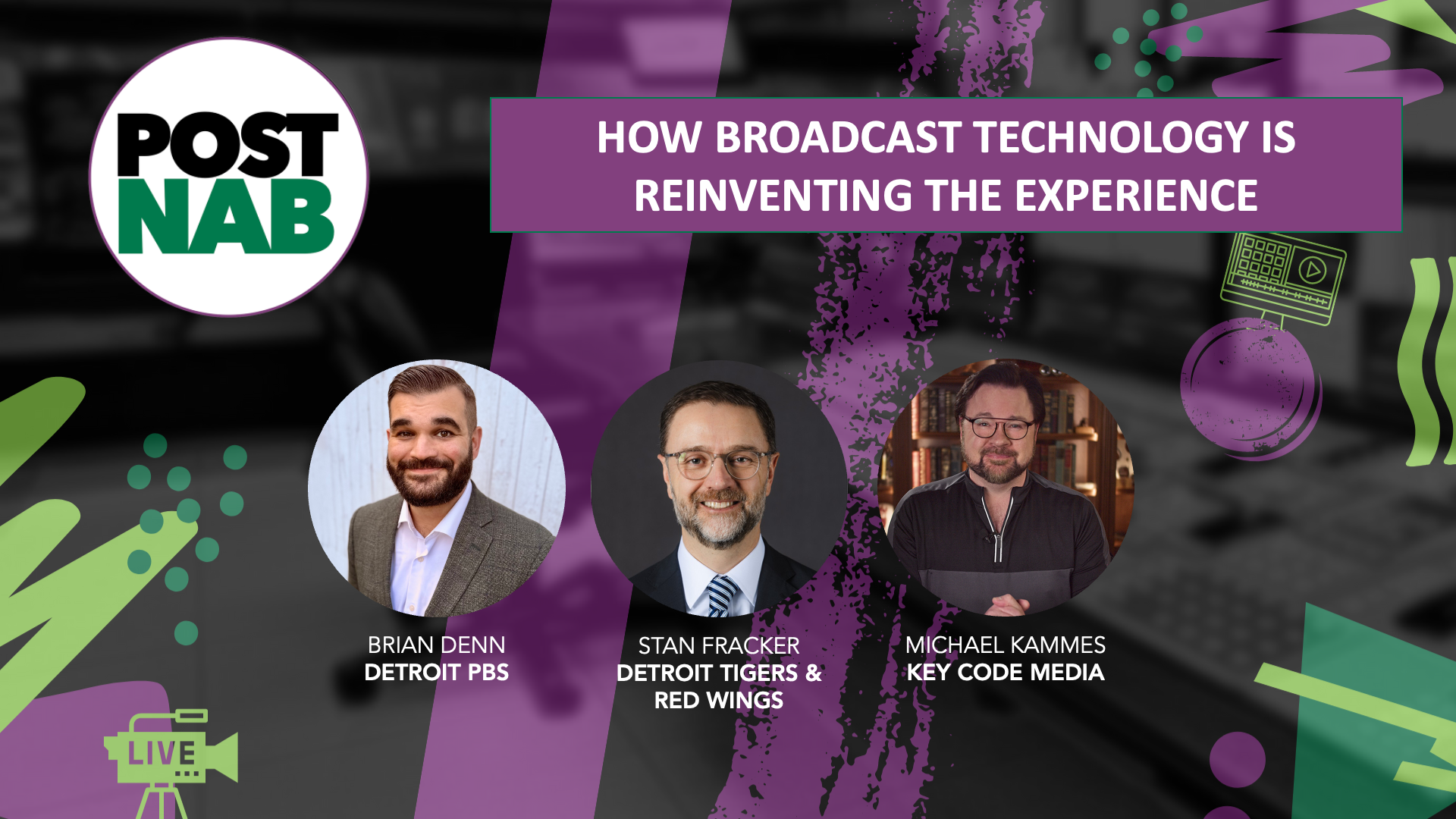
[00:37:54] Speaker A: Okay, well, thank you very much for joining us. Brian from Detroit pbs, Stan Fracker from Detroit Tigers and the Red Wings. Thank you so much for your information. Thank you so much for your time. Thanks for watching Broadcast to Post. Don't forget to follow Key Code Media on social and contact us about your
[email protected].